

Cloud Service Providers (CSPs) who either currently work with the federal government, are in the process of earning FedRAMP certification, or are considering seeking it, all have a serious choice to make.
FedRAMP is changing.
If you haven't been watching the world of government compliance, or if you've been putting off making a decision until a deadline gets closer, it's here.
As a CSP, what do you need to know, what decision do you need to make, and how will it affect your path with government contracts?
 BLUF - Bottom Line Up Front
CSPs must choose between FedRAMP Rev5 and FedRAMP 20x. 20x cuts approval time with machine-readable evidence and Key Security Indicators and will become the standard. A phased timeline runs from 2026 to 2030. Strategy depends on status: Class D stay on Rev5; if little done, start 20x; if mid-process, finish Rev5 then switch; if already authorized, keep security posture and prepare for 20x. Coordinate with agency sponsors; Ignyte can help.
FedRAMP Rev 5 Explained
FedRAMP, the Federal Risk and Authorization Management Program, was created in 2011 as a response to the increasing level of risk faced by government contractors. It standardized the security required to be part of the overall governmental ecosystem, to ensure that sensitive and controlled but unclassified information is protected against outside threats.
Over the years, the FedRAMP system has been reevaluated and updated to increase and adjust standards, alleviate tension and confusion, and optimize security throughout the federal government contractor roster.
In May of 2023, FedRAMP's revision 5 was released. Until now, this has been the most up-to-date baseline for federal government security, not counting other frameworks like the DoD's CMMC.

Over time, weaknesses in FedRAMP have become increasingly apparent. In particular, the high degree of required security, documentation, and assessment means that a full authorization takes a very long time.
For most CSPs (the 80% of CSPs who fall into the Moderate baseline), it could take 4-8 months for analysis, gap assessment, and implementation, another 3-4 months for a 3PAO assessment, and yet another 4-6 months for agency/PMO review and authorization.
From start to finish, it routinely took over a year for a CSP to obtain authorization to start working with government agencies.
We live in a world where information security threats are rapidly evolving. A year from now, the level of sophistication in the threat environment will be extremely different. Compliance can't take that long and still be effective.
What is FedRAMP 20x?
FedRAMP 20x is the next generation of the FedRAMP framework. It does a lot to change the way FedRAMP works, from changing the authorization paths, to streamlining the change request process, to a serious investment in machine-readable and automatic security validation over narrative-based human assessments.
This modernization effort has been going through pilot phases with a limited selection of pre-qualified CSPs, but it is already bearing fruit. Where the prior authorization path could take over a year, the new 20x path has seen CSPs complete it in under three months.

With Rev5, CSPs would be asked to adhere to hundreds of security controls, provide proof and explanations for each of them, and undergo periodic assessments from 3PAOs to evaluate that compliance. Since this required a lot of human effort and human review, there was both a long timeline and a lot of room for variance and misinterpretation.
FedRAMP 20x changes this through the use of machine-readable telemetry and evidence, as well as the introduction of KSIs.
KSIs, or Key Security Indicators, are specific, tangible pieces of evidence that prove security has been implemented in a given way, for a given security control. Some controls have a laundry list of KSIs; other controls have no KSIs at all. This changes, but more importantly, dramatically speeds up assessment.
Is FedRAMP 20x Mandatory?
Yes, but not quite yet.
Make no mistake; FedRAMP 20x is the future of the FedRAMP framework. It will, in time, be the only way to comply with FedRAMP as a whole, and thus the only way to work on federal government contracts.

The timeline is at once fast (as far as government actions are concerned) and slow. Technically speaking, FedRAMP 20x is still in the pilot process.
- Phase 1, testing of FedRAMP Low (now Class A) and proof of concept. This completed at the end of 2025.
- Phase 2, testing and analysis of FedRAMP Moderate (now Class C) and ironing out the major kinks in the process. This completed just a short time ago, in FY26 Q2.
- Phase 3, active as of the time of this writing, is the broad expansion of FedRAMP 20x. This makes the 20x authorization path available to all Class A, B, and C CSPs.
- Phase 4, the small-scale pilot for Class D (currently FedRAMP High) CSPs, will begin at the start of 2027.
- Phase 5, currently slated for the middle of 2027, is the beginning of the end for FedRAMP Rev5. While there's still room for things to change between now and then, the likelihood is looking slimmer and slimmer.
The official milestone for the implementation and availability of FedRAMP 20x is the release of the 2026 Comprehensive Rules overhaul, CR26. This released last month (as of this writing), meaning that FedRAMP 20x is now available to all CSPs at the former Moderate or below baseline.
Why CSPs Aren't Jumping on 20x Just Yet
FedRAMP 20x promises a lot of benefits for CSPs. It's much more automated and much faster to authorize and evaluate the security of an organization. The burden of paperwork is slashed, with machine-readable KSIs taking over the majority of the burden. What used to take a staff of dozens a year to complete can now be done with a handful of people in a few months.
At the same time, there's still a lot of confusion, a lot of learning to be done, and a lot of changes to be made.
CSPs can't simply change "Rev5" to "20x" on their paperwork and call it a day. FedRAMP 20x requires a lot of very important, very tangible changes to the way you implement your security, the way you report on your results, and even the way you monitor your current state.

There are a few major reasons why CSPs are currently hesitating.
The deadline is still a way out. While CSPs are now able to start with the FedRAMP 20x process, it will be another year before applications for new Rev5 authorizations are no longer accepted, and even longer before the conversion is required in currently-authorized CSPs. CSPs need to reauthorize every three years; that means it won't be until 2030 before everyone at Class C or below will need to have made the leap. For current High baseline CSPs, the deadline is even longer.
Adaptation requires a significant change in perspective. In particular, going from a team that is specialized in knowledge, narrative, and paperwork, to a team that focuses on technical solutions, automation, and machine-parsed data is a significant jump for many CSPs.
For some CSPs, this will require some engineering know-how and some time to adapt and implement new systems. For others, particularly those built on custom reporting tools and legacy applications, it can require a fully new solution engineered for the business. This can be a significant investment and will take time to implement.
It's not just on the CSPs to change. Government agencies have a role to play in all of this, as do 3PAOs. Even if you, as a CSP, want to adopt FedRAMP 20x right away, you might not have the readiness from your sponsoring agencies or your current contracts. It can also take some time to find a 20x-ready 3PAO. Getting full alignment between all of the major players is going to take time, even when the willingness is there.
Why It Makes Sense to Continue with FedRAMP Rev5
For some CSPS (not all, but some), sticking with the current FedRAMP Rev5 path is the way to go.
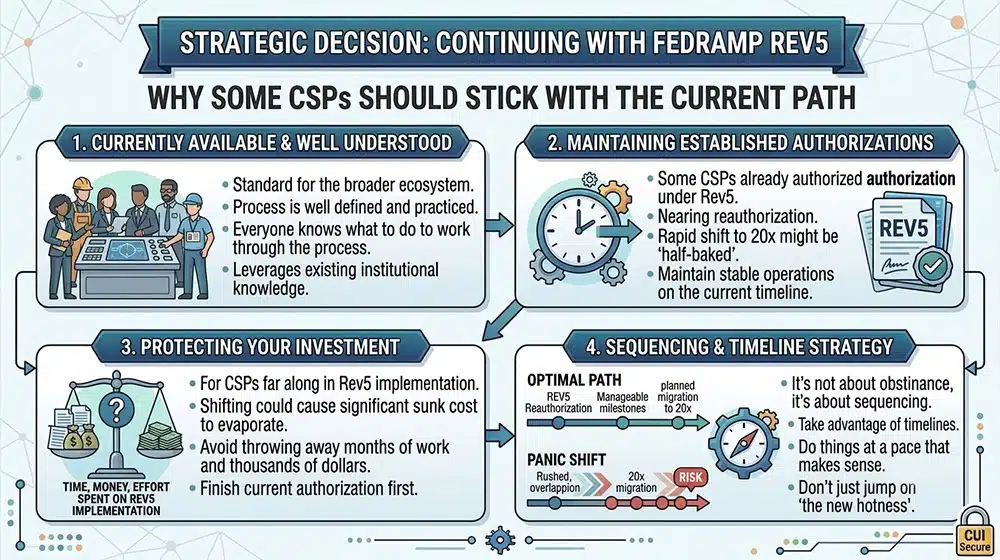
It's currently available and well understood. Contractors, consultants, 3PAOs, agencies, and every other element of the broader FedRAMP ecosystem are already used to it, know how it works, and know what to do to work through the process.
Some CSPs are already authorized under Rev5 and are rapidly approaching their reauthorization. There's no reason to make a rapid, likely half-baked shift to 20x just to sneak in under the deadline. Sticking with Rev5 for now, and shifting to 20x on a longer timeline, is a more sensible choice.
Some CSPs are a good way through the implementation process for Rev5, even if they haven't achieved authorization yet. Some of these will find it acceptable to shift to 20x, but many will have spent a lot of time, money, and effort on Rev5 implementation in a way that simply evaporates when trying to transition. If you've spent months and thousands of dollars on gathering paperwork that is no longer necessary, it doesn't make sense to throw it all out, right?
It's not a matter of obstinance or resistance to change. It's more a case where sequencing is important. Take advantage of the timelines and do things at a pace that makes more sense, rather than jumping on the new hotness just because it's there.
A Practical Strategy for Rev5 and 20x
The appropriate set of steps to take, right now, depends on where you are in the authorization process, as well as what your goals are.
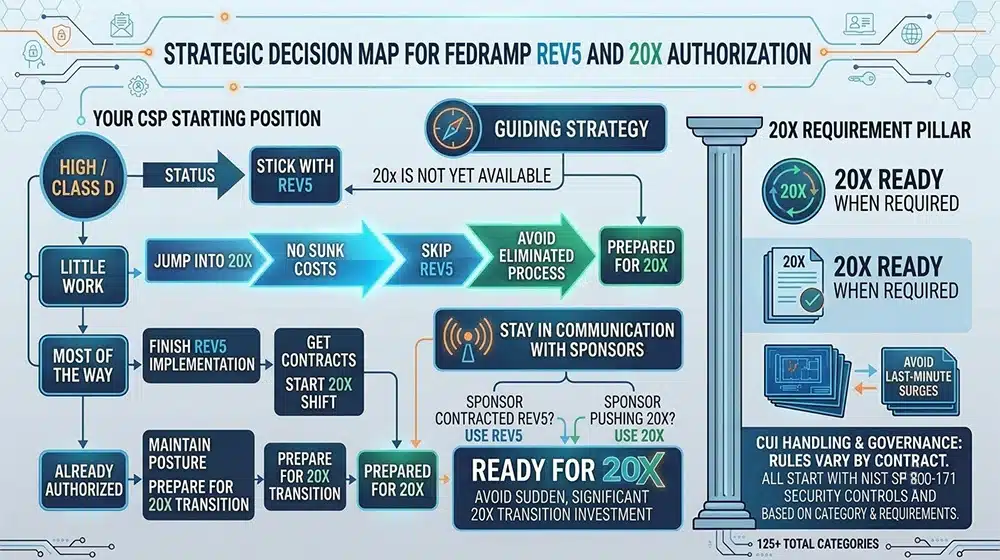
First: if you are a FedRAMP High (now Class D) CSP, stick with Rev5. 20x is not yet available to you, and won't be for a while, so you don't have a decision to make yet.
If your CSP is hoping to seek authorization, but you've done very little in the way of implementation yet, then you're in the perfect position to jump right into FedRAMP 20x. With no sunk costs and no work to discard, there's no reason to go into the longer process when it's about to be eliminated.
If your CSP is most of the way through a Rev5 implementation, see it through. Get those contracts, get the bag, and then start working on the shift to 20x. You have leeway before you need to have it implemented, so getting the government work first and foremost should be the priority.
If your CSP is already authorized under Rev5, maintain your security posture and start working on the transition to 20x. Again, you have some time before reauthorization will require you to use FedRAMP 20x, so take advantage of that timeline.
Above all, stay in communication with your agency sponsors and contractees, and follow their guidance. Even if you're more or less 20x ready, if your agency sponsor is still working for Rev5 and has Rev5 in their contract language, you'll want to use Rev5. Conversely, if your agency is pushing to adopt 20x sooner rather than later, follow along.
The overall goal is to be ready for 20x when it's required for your CSP. You need to avoid getting stuck in Rev5 compliance in a way that requires significant investment in short order to make the transition. Even if 20x isn't fully mandatory yet, that deadline will come eventually, and you need to be prepared for when it does.
How Ignyte Can Help
Here at Ignyte, we've been following the shift from FedRAMP Rev5 to 20x very closely. This represents a major shift in how compliance will be handled, and we want to be available and effective for any CSP that needs our services.
The good news is, we can help, no matter what path you choose to take. Want to jump right into 20x? We're ready and able to help. Want to stick with Rev5 and work on 20x over the next year? Our assurance platform is a perfect tool to help. Unsure of what direction to take and what deadlines matter for you? Our experts know the plan as much as anyone not part of the PMO can. Reach out and ask, and we'll do our best to help you navigate this transitional time.

Above it all, it's worth remembering what this is all about. It's not about winning lucrative contracts or establishing machine-readable KSI reporting. It's about securing sensitive information. Whatever path makes the most sense to secure information appropriately, for now and in the future, is the path that should be taken. That path can be different for different CSPs, but as long as we all recognize that we have the same goal and the same destination, we'll get there together.

Max Aulakh is a distinguished Data Security and Compliance leader, recognized for implementing DoD-tested security strategies and compliance measures that protect mission-critical IT operations. His expertise was shaped in the United States Air Force, where he was responsible for the InfoSec and ComSec of network hardware, software, and IT infrastructure across global classified and unclassified networks. He also developed strategic relationships with military units in Turkey, Afghanistan, and Iraq. After his tenure with the USAF, Max played a pivotal role in driving Information Assurance (IA) programs for the U.S. Department of Defense (DoD). As a Senior Consultant for a leading defense contracting firm, he led a team that ensured data centers met Air Force Level Security audits for regulatory requirements like HIPAA, SOX, and FISMA. Currently, as the CEO of Ignyte Assurance Platform, he is at the forefront of cyber assurance and regulatory compliance innovation, catering to defense, healthcare, and manufacturing sectors. Max is also an esteemed speaker, having presented at several conferences on topics including cybersecurity GRC, medical device security, and cybersecurity perspectives in vendor management. You can follow him in LinkedIn here.