

The power of FedRAMP comes from standardization. By setting a firm baseline and forcing cloud service providers to adhere to it if they want to work with the government, a certain mandatory minimum level of security is enforced.
A key part of FedRAMP as a security standard is that it’s not a fire-and-forget system. Instead, it involves constant, active vigilance through a process called continuous monitoring. ConMon is how a CSP keeps tabs on both their internal security and the standards and threats in the world at large, and makes proactive changes to stay secure as the environment changes.
FedRAMP strives to ensure that everyone who is granted an authority to operate with the government is maintaining a minimum mandatory level of security across the controls set out in the framework. That maintenance is an active process, and means a lot of day-to-day changes need to be made.
Whether it’s patching software, changing security configurations in a firewall, writing new anti-phishing email rules, or whatever else, there are constant changes made to a CSP’s security to stay in compliance with FedRAMP standards.
Sometimes, though, a change is larger and more significant. Changes made to the CSP itself, which can alter how security is handled, can put a company out of compliance with FedRAMP.
How does FedRAMP handle this kind of situation? In the past, the answer was “not well”, but we’ll get to that. The answer, in general, is through the Significant Change Request process.
 BLUF - Bottom Line Up Front
 BLUF - Bottom Line Up Front
FedRAMP enforces a base level of cloud security through standard rules and constant oversight. Significant Change Requests (SCR) need prior approval for adaptive or transformative changes and can take 3–4 months; unapproved major changes can void authorization. New optional Significant Change Notifications (SCN), available Feb 2026, let providers make major changes first then notify and show security evidence; adaptive changes must notify customers within 14 days, transformative changes need 3PAO review first.
What is a Significant Change Request?
A Significant Change Request is a specific process in the ConMon section of FedRAMP. The concept is simple, but the execution is complex.
First, the technical definition. Significant Changes are defined by the National Institute of Standards and Technology in NIST SP 800-36 as:
“A change that is likely to substantively affect the security or privacy posture of a system.”
Beyond that, significant changes are defined in four broad categories:
- Routine Recurring
- Adaptive
- Transformative
- Impact Categorization
Of the four kinds of changes, only the latter two (adaptive and transformative) require going through the Significant Change Request process.
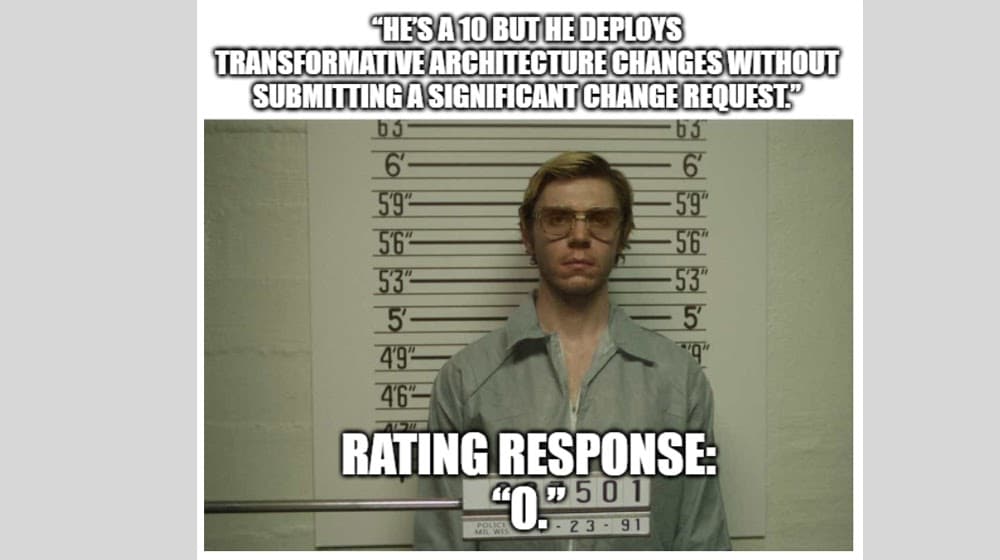
Routine Recurring changes are changes that are either routine enough or require a fast enough response that going through a whole process to implement them would be a security hole itself, so they are excluded from the SCR process.
Impact Categorization changes, meanwhile, are too significant. If a change to your business would change your FedRAMP impact level, you need to undergo reauthorization at the new standard, and you can’t “backdoor in” using an SCR instead.
You may notice that “an adaptive change” or “a transformative change” is not particularly descriptive. This is a common pain point for CSPs: What actually constitutes a significant change? What kinds of actions can trigger the need for a significant change request?
What Triggers a Significant Change Request?
The kinds of changes that do and don’t trigger significant change requests can be very contextual. In part, it even comes down to your environment and architecture. Some businesses operate in a modularized and containerized way that allows for fairly robust changes without the need for SCRs; others making the same changes could require the SCR.
For the most part, these changes go beyond simple alterations to configurations, patches in software, or routine updates. They encompass things such as:
- Major changes to your system architecture.
- Implementing new system components that need to be secure.
- Modifying the system boundary and scope.
- Adding new services or features, especially involving data processing or user interaction.
- Moving to a new data center.
- Changing cloud hosting providers.
- Significantly altering underlying infrastructure.
- Large changes to how security controls are implemented.
- Changing or adding integrations to external systems.
This is an incomplete and non-comprehensive list, but it can give you an idea of the kinds of changes that are going to constitute significant changes and thus require going through the SCR process.
A good rule of thumb is to consider the change you want to make in the context of security controls. Does the change fundamentally alter how a control is handled? If not, like changing small configuration rules, it doesn’t need an SCR. If yes, like adjusting scoping, it does.
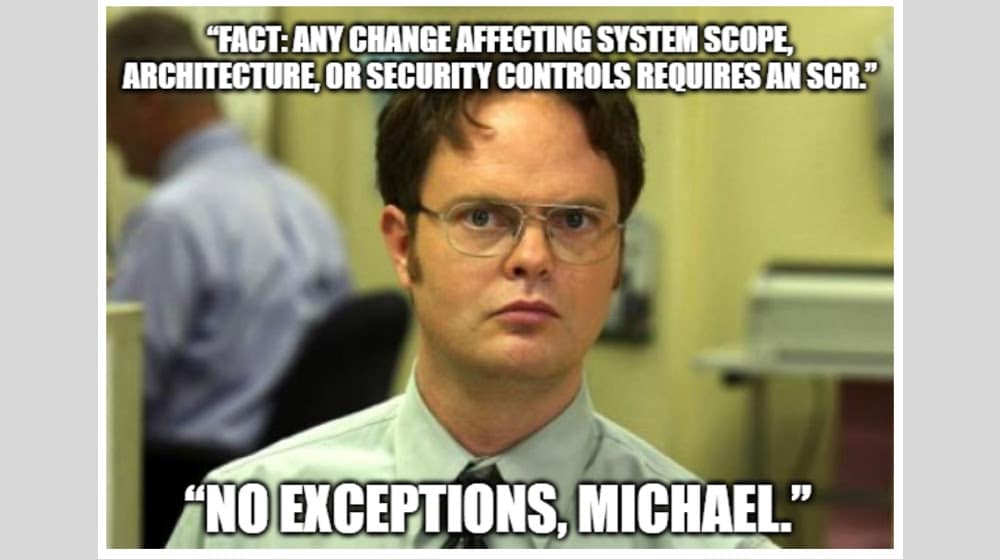
Transformative changes are changes that transform existing services or control implementation. Altering a service risk profile, changing design or bringing in new development, extensive security updates; these can put a change in the transformative category.
Examples can include things like replacing third-party services, changing from bare-metal to virtual services, migrating data centers, or adding AI capability.
Adaptive changes, meanwhile, are changes that don’t significantly modify underlying systems, but adapt existing systems. They can include changes to security plans, underlying software, or verification processes.
Examples can include updating operating systems, software, or libraries across significant versions (i.e., Windows 10 to Windows 11), changing cryptographic modules, replacing like-for-like components, or adjusting the models in an existing and approved AI system.
How Do You Process a Significant Change Request?
The actual significant change request process is quite detailed and can take some time, but it’s an “ask for permission” process. If your CSP needs to make a significant change, you must get approval to make that change before implementing it, otherwise you risk jeopardizing your FedRAMP authorization.
The first step is to meet with your assessment organization to discuss the need for an SCR. You will discuss the change that you want to make, why it needs to be made, and why you think it needs an SCR. The assessment organization will help you determine if it needs an SCR or if it doesn’t meet the standards. A Security Impact Analysis is a great tool to help with this step.
If the change is determined to be a routine recurring change, you can make the change and carry on as normal. If it’s determined to be impact adjusting, you’ll need to re-evaluate if it’s a change you want to make, and if so, undergo the full security assessment process at the new impact level.
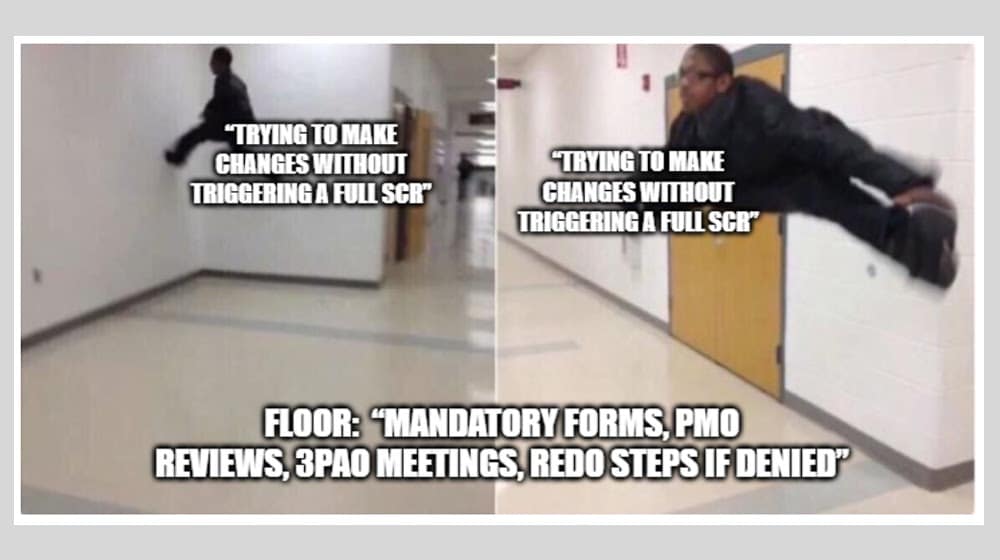
If the change is determined to be adaptive or transformative, you then follow the rules for an SCR. This involves filling out the Significant Change Request Form, which asks for information about the company, the system, the 3PAO, and the change. You’ll need to outline the change, what security controls are impacted, and how you’re adjusting security and validating after the change is made.
You will also need to justify why you’re making the change. Are customers demanding it? Is it to adjust to new industry standards, or to future-proof for new security? Is it in response to new threats? The actual reason doesn’t matter so much as the fact that you have a valid reason and aren’t just making changes arbitrarily.
Once you submit this information, the FedRAMP program management office will review the request form and either approve it, request more information, determine it’s of a different classification and request different information, or deny it. As usual, you’ll work with the PMO and your 3PAO to navigate this process.
The Critical Flaw with the SCR Process
There has been a pretty big flaw with the SCR process.
If you make a significant change without having gained approval through an SCR, it can put your FedRAMP authorization at risk. Depending on the scope of the change and the severity of any security gaps, it can remove your authorization to operate, force you out of the FedRAMP ecosystem, and even temporarily ban you from operating with the government or reapplying. At best, you’ll have to undergo the full FedRAMP authorization process again, which can take a year or longer.
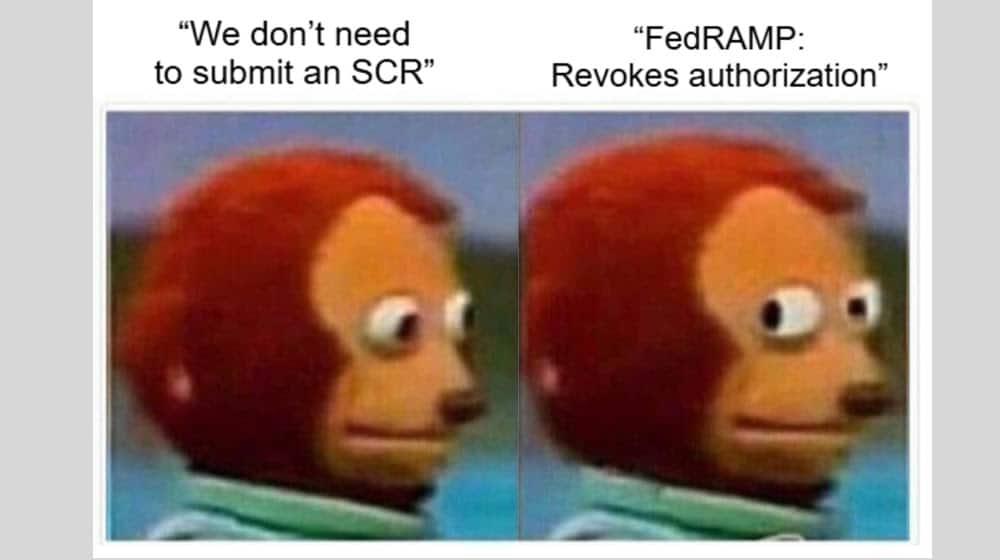
If you make a significant change using the SCR process, you’re in full compliance, but it puts a lot of suppressive pressure on your business. That’s because the SCR process takes 3-4 months on average, so any significant changes need to be planned at least a quarter in advance. It hinders your ability to be an agile business in an environment where agility is a competitive advantage.
The alternative, of course, is stagnation. You don’t have to engage with the SCR process if you don’t make a significant change, right? Except the way technology evolves and security changes, you’ll likely need to go through it sooner or later anyway. The more you put it off, the more difficult and the larger the change it will be.
One commonly accepted workaround was to intentionally schedule significant changes alongside your annual assessments, to make the change and validate security at the same time. This can work, though it requires buy-in, and it also further delays agility.
Fortunately, FedRAMP has been making some pretty big changes, and the significant change request process is seeing some much-needed attention.
FedRAMP’s New 20x Changes to SCRs: Significant Change Notifications
Everything we’ve written above about the SCR process can, potentially, be discarded. Not because it’s not relevant, but because there’s a new process you can consider using instead.
If the SCR process is the “ask for permission” process, the new Significant Change Notification process is the “ask for forgiveness” process.
As of the end of February 2026, the new Significant Change Notification process is available to all FedRAMP cloud service providers. To quote the PMO directly:
“One of the largest historical incentives for the creation of government-specific versions of cloud services is being removed this month: cloud service providers will no longer be required to ask the government for permission to improve their own service just because they have a government customer. Instead of relying on the Significant Change Request process, cloud services may adopt the new optional Significant Change Notifications process.”
Significant Change Notifications are optional, so if you’re in the middle of working through the SCR process, or prefer not to change the way things have worked until you have to, then all of the above is still valid. If you want to streamline and improve your significant changes and return to agility, then the new SCN process is better for you.
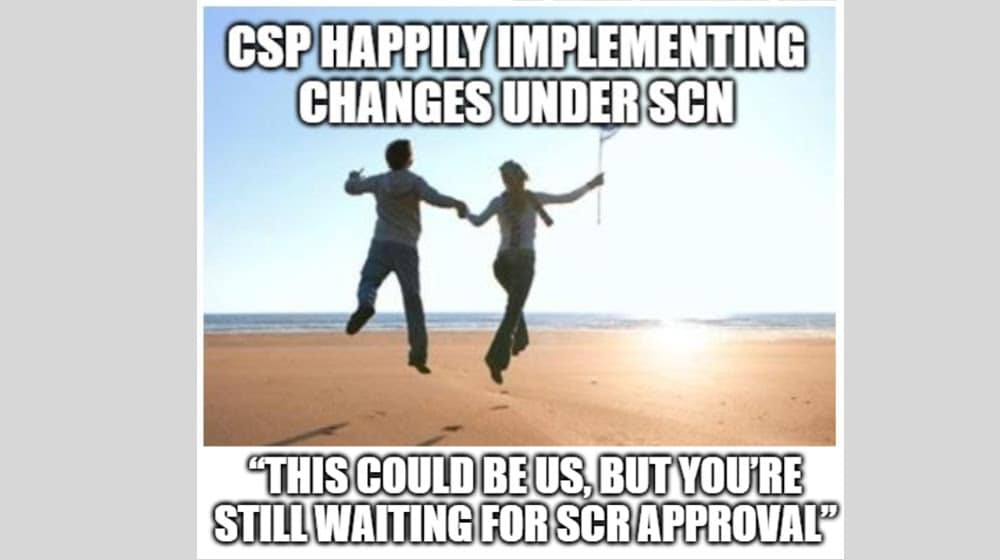
In practice, the process overall is still similar. You still need to carefully plan your significant changes. You still need to evaluate any major change in terms of how it impacts security. You still need to validate any changes according to the security controls impacted by the change. You also still need to consider if the change would be classified as routine recurring or impact adjusting, and act accordingly.
For adaptive and transformative changes, though, the process is a little different now. Instead of planning the change, documenting the impact, and submitting an application for permission to make the change, you now plan the change, document the impact, and implement the change. Then, you submit your notification of the change, as well as validation of the security posture afterwards, to the FedRAMP program management office.
Adaptive changes need to notify their FedRAMP and agency customers within 14 days after making the change. Transformative changes have more work behind them, including working with the 3PAO to evaluate scope and impact before making the change, to ensure it’s not the wrong kind of change.
It’s also worth noting that if you have written into your government contracts that you need to use the traditional SCR process, you can’t replace it with the SCN process without changing the contract. Fortunately, this change is being aggressively pushed by the FedRAMP organization, with the intent of most significant changes using the SCN process by the end of 2026.
The key to successfully implementing a significant change is documentation, and that means having a good tool at your disposal to handle that documentation. Here at Ignyte, we’ve made exactly that tool. The Ignyte Assurance Platform is our tool made for monitoring and documenting everything in the FedRAMP process, from initial compliance to continuous monitoring and, yes, significant changes.
We routinely help CSPs cut their approval time from 12+ months to under 6 months, and we help ensure that you can handle any and all annual reporting, change requests, and other assessments with ease.
To see how it can do this for you, just reach out to get started with a demonstration. We think you’ll like what we have to show you.

Dan Page is a seasoned Cybersecurity and Risk Management Executive known for advancing security programs aligned with complex regulatory frameworks and critical business objectives. With over 12 years in information security, his expertise began in the U.S. Army Signal Corps, where he led global communications and secured classified networks supporting Special Operations missions. Post-military, he specializes in security architecture for CUI, ITAR data, and federal cloud workloads. Currently, as Senior Cybersecurity Manager at Ignyte Assurance Platform, Dan guides organizations through compliance with CMMC, FedRAMP, ISO 27001, PCI, and NIST standards. A CISSP, CRISC, CISM, PMP, and ITIL-certified professional, he is also a cybersecurity lecturer and community volunteer advocating workforce development.