

Kubernetes is an extremely powerful tool for scaling, automating, and managing applications and systems. There's a reason it has become industry standard, with over 80% of container-using enterprises running K8s, encompassing over 60% of enterprises in general.
It makes sense that, sooner or later, Kubernetes users will need to contend with the FedRAMP framework and the security requirements necessary to maintain operations.
Fortunately, this is generally a good thing. Kubernetes offers a lot of features that play well with FedRAMP security requirements, it's well-documented to ensure easy compliance, and there are even STIGs specifically for Kubernetes systems.
FedRAMP this year is investing more and more into streamlined, automated adherence to security standards, a trend that will likely continue into 2027 and beyond. A business using Kubernetes is uniquely situated to take advantage of some of these changes, achieve a FedRAMP authorization to operate, and win government contracts quickly and easily.
What do you need to know to successfully secure your systems to FedRAMP standards while using Kubernetes? Let's walk through it.
 BLUF - Bottom Line Up Front
Kubernetes powers container platforms: over 80% of container users run it and over 60% of enterprises use it. FedRAMP will matter to Kubernetes operators, and Kubernetes features align with FedRAMP security needs. Build a detailed System Security Plan (SSP); choose a 3PAO with Kubernetes experience; use automation and POA&Ms; keep constant checks and immutable audit logs; automate account lifecycle; watch configuration drift; follow CIS benchmark; patch Kubernetes; set clear scope and boundaries; generate docs.
Establish Your System Security Plan
Your system security plan, or SSP, is the most critical document in all of your FedRAMP implementation. It's the keystone of implementation, detailing everything you'll be doing throughout your business. It's also one of the most common stumbling blocks, with SSP issues making up a majority of the delays in auditing and successful ATOs.
In brief, your SSP has to be a rundown of every FedRAMP security control at your impact level, with a discussion of how it applies to your business, and how you're implementing security for that control to achieve FedRAMP standards or greater.
As far as Kubernetes implementations are concerned, you will need to outline your Kubernetes architecture at a detailed level. Map and discuss your overall architecture, your clusters, your components, and your access layers, all of which play a role in your security.
You will also want to map out your technical details in terms of security implementation. In particular, security elements like access control by role (RBAC) and your pod security policies will need to be documented.
Kubernetes also doesn't operate in a vacuum; you will get security from the cloud services you use as well. Inherited controls and security from providers like Azure or AWS will also need to be documented in your SSP.
Make Use of Automation
If you're invested in Kubernetes, you're likely well aware of the power of automation. FedRAMP is also embracing automation, particularly with elements of common security configurations that make up part of the security controls in FedRAMP's various baselines.
What this means is that, between the STIGs, the common documentation for Kubernetes security, and the various automated tools available for FedRAMP compliance, you can get a lot of your work done using automated tools. From container security configurations to role-based access control and MFA to other elements of technical security, you can automate implementing most of it.
Pick the Right 3PAO
While you can work with a 3PAO in a consulting role in the process of implementing your security, you can't hire the same 3PAO to perform your auditing, to avoid conflicts of interest. Many FedRAMP hopefuls hire non-3PAO consultants to work with them on building their security, and work with a validated 3PAO for the audit and ATO recommendation.
One thing you will want to look for when browsing the FedRAMP 3PAO marketplace is to find a 3PAO that understands your systems. Kubernetes is common, but that doesn't mean every 3PAO is familiar with it. When you're reaching out to potential 3PAOs to conduct your audits, make sure they're familiar with how Kubernetes operates and what specific security measures, configurations, monitoring options, and other details are unique to the system.
Alternatively, you can skip most of that interview process and reach out to us directly. After all, we're writing this guide for you. We're more than happy to work with you for your FedRAMP ATO, both as a 3PAO or as a consultant and provider of the Ignyte Assurance Platform. We designed the platform to be a powerful tool for monitoring and maintaining compliance without siloed and proprietary software getting in the way. To see how it can work for you, just reach out for a demo.
Make Use of POA&Ms
No one is perfect. There's a pretty good chance that, even with experts and high-quality tools in your corner, you're still going to have issues in your audit.
The good news is, as long as you haven't missed any of the really important controls, missing a detail here and there won't jeopardize your ATO. Instead, you're able to use Plans of Action and Milestones.

POA&Ms are the official way to implement a compliance roadmap after an audit. When your 3PAO delivers their security assessment report, anything that falls out of compliance can be addressed with a POA&M. You describe the control, describe what needs to happen to fix the deficiency, assign it to a specific person to hold responsibility for it, and set a timeline to fix the problem.
As long as you submit and live up to these roadmaps, you can achieve your authorization under FedRAMP with as few bumps in the road as possible.
Establish Continuous Monitoring
FedRAMP, like all information security frameworks, is not a one-and-done goal to meet. It's a moving target and a living set of security guidelines that change over time. They can change in response to industry or niche threats, along with evolving technology, or from changing standards set by NIST or FedRAMP itself.
The key to success is monitoring, both active and passive, in ways that watch for vulnerabilities, changes, and intrusions. How you do this depends a lot on the specific systems you're using, but many of the techniques remain the same: logging, internal auditing, active monitoring, and more.
Kubernetes is deeply integrated with continuous integration and continuous delivery pipelines, which is a perfect source for integrating continuous monitoring. In fact, there are many third-party tools aimed at exactly that purpose, with security in mind.
Specific Tips for Kubernetes in FedRAMP
Now let's get into the weeds with some of the more specific tips we can offer in terms of securing a business using Kubernetes.
Automate Account Management Lifecycles
Accounts need to be created, granted the bare minimum permissions and access necessary to do their job, audited and monitored when accessing sensitive systems, and removed when they're no longer in use. This is, broadly, the life cycle of an account, tied to the role and employment status of the individual who owns the account.

Kubernetes, fortunately, offers automated features for lifecycle management, including government-specific identity provider data and other salient details. With a little customization, it can be implemented to handle much of your account life cycles automatically.
Establish Immutable Audit Logging
Part of FedRAMP is the paper trail, digital though it may be. Your auditing policy, your internal audits and their results, your audit logs, and all other logs need to be maintained according to compliance rules and industry data regulations.

It's likewise critical that your logging and auditing is not, itself, possible to tamper with. Several FedRAMP security controls center around auditing and the security of audit logs, so you'll want to use Kubernetes configurations to create these immutable audit trails.
Use Monitoring to Flag Configuration Drift
A common threat to many organizations is not any one significant event, but rather the slow change of systems over time. As systems grow and scale, as accounts shuffle and change, as people move through positions, as software updates and patches, things change. Configurations can be reset here and there, formats change, details shift.
All of this, cumulatively, is known as drift. Small discrepancies may not be impactful individually, and can be noticed and fixed on their own, but over time, the details can add up. As the drift expands and gets worse, the risk it represents gets higher.
Kubernetes offers automation options for checking and validating configurations, and flagging drift outside of acceptable parameters. This can be a proactive way to identify potential risks and fix issues before they become problems.
Review the CIS Benchmark
The Center for Internet Security offers a Kubernetes benchmark document, which is an industry-standard set of benchmarks for Kubernetes security. This is not a one-to-one set of standards equivalent to FedRAMP, but it does offer a very powerful and secure baseline that you can use as a foundation to build up to FedRAMP standards. Further, as a broadly accepted security standard, it's battle-tested and hardened against known threats.
Additionally, the CIS standard benchmark is accessible using specific tools and further automation, allowing you to implement much of what it contains quickly and automatically. If you're struggling to start with a Kubernetes system that didn't pay attention to security before, this can be a great place to start.
Much of the CIS standard can be implemented automatically using tools like kube-bench as well, making it a low barrier avenue to baseline security.
Pay Attention to Boundaries and Scope
One key to successful FedRAMP implementation is scoping. A big part of why you map out your architecture as one of your first steps is to define which systems, which clusters, and which containers are within the scope of FedRAMP, and which don't need to be secured to the same level.
One huge benefit of containerized systems is that those containers can be secured more easily, and the boundaries between these systems and out-of-scope systems are much easier to define.
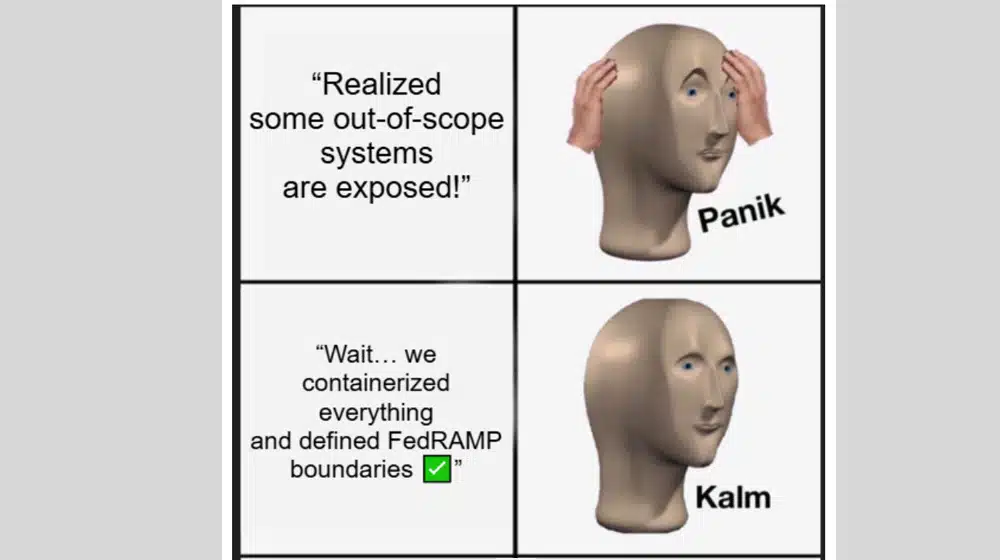
Boundary protection, likewise, is easier to define with Kubernetes. Preventing out-of-bounds traffic and cross-communication is easy.
Automatically Generate Documentation
Another powerful feature of Kubernetes is the ability to easily export a documented version of security and cluster configurations, which, when formatted properly, is already acceptable as part of your system security plan documentation. Here's an example of what that looks like.
It doesn't take much code to export and document your system configurations in a way that easily facilitates both documentation requirements and auditing.
Maintain Patched Kubernetes Software
It should go without saying, but a huge reason software gets patched on a regular basis is to address security vulnerabilities. Sometimes they're internally discovered and never used; other times they're externally discovered and weaponized. Either way, patching the problem helps prevent it from becoming a source of intrusion.
Kubernetes has an advantage in that, as a large and widely adopted system, it's well-maintained by a large number of industry experts. When flaws are found, they can be easily reported and quickly fixed, and patching is generally a simple process (or at least, as simple as it ever is.)
This is part of continuous monitoring and ongoing security, and can be at least semi-automated in terms of cross-cluster patching and vulnerability scanning.
Don't Be Afraid of FedRAMP Standards
FedRAMP compliance is often talked about as if it's an endlessly expensive implementation that takes years of constant effort, has a high chance of failure, and puts entire companies at risk when it doesn't go smoothly. This often turns off businesses that would otherwise be excellent candidates for FedRAMP-secured government operations.
The truth is, while the standards are high, costs are more reasonable than ever before, and the increased focus on automation and tool-based security allows for a lot easier implementations than were previously possible.
It's something to take seriously, but not something to be afraid of.
At Ignyte, we've definitely seen our share of Kubernetes-based businesses looking to gain approval in security frameworks like FedRAMP, as well as CMMC, ISO 27001, and more. The fact is, you're in a great place to implement that security just by using a system like Kubernetes in the first place.
So, use the tools available to you. Whether those are automation tools within Kubernetes itself, or external tools like the Ignyte Assurance Platform, we've got you covered. To see how our platform can work for you or to discuss potential 3PAO services, simply reach out and talk to us today. We're sure we have something for you.

Max Aulakh is a distinguished Data Security and Compliance leader, recognized for implementing DoD-tested security strategies and compliance measures that protect mission-critical IT operations. His expertise was shaped in the United States Air Force, where he was responsible for the InfoSec and ComSec of network hardware, software, and IT infrastructure across global classified and unclassified networks. He also developed strategic relationships with military units in Turkey, Afghanistan, and Iraq. After his tenure with the USAF, Max played a pivotal role in driving Information Assurance (IA) programs for the U.S. Department of Defense (DoD). As a Senior Consultant for a leading defense contracting firm, he led a team that ensured data centers met Air Force Level Security audits for regulatory requirements like HIPAA, SOX, and FISMA. Currently, as the CEO of Ignyte Assurance Platform, he is at the forefront of cyber assurance and regulatory compliance innovation, catering to defense, healthcare, and manufacturing sectors. Max is also an esteemed speaker, having presented at several conferences on topics including cybersecurity GRC, medical device security, and cybersecurity perspectives in vendor management. You can follow him in LinkedIn here.