

One of the jobs of the National Institute of Standards and Technology is to keep on top of new technologies as they are developed and evolve. This is particularly important for risk management, considering both of the major governmental information security frameworks (FedRAMP and CMMC) are based on NIST publications.
Well, as you might imagine, Artificial Intelligence technology is a huge new risk factor. Not only is AI allowing for conventional cyberattacks at massive scales, but it's also becoming a new vector, both as an attacker and as a technology that can be exploited by attackers.
While NIST itself is not creating or enforcing security frameworks like CMMC, it's responsible for analyzing and providing a baseline that security frameworks can adopt as part of their planning. Often, while individual companies and security firms can do their own legwork and adopt their own risk management, NIST is among the first to provide a standardized baseline for larger and slower-moving entities like the government.
Enter the NIST AI RMF. What is it, what does it include, and how can you adopt it? Let's dig in.
 BLUF - Bottom Line Up Front
NIST tracks new technology and sets a voluntary AI Risk Management Framework that forms the base for FedRAMP and CMMC. The AI RMF gives four core functions: Govern, Map, Measure, Manage, and seven trust principles: validity, safety, security, accountability, explainability, privacy, fairness. It has no certification and helps organizations that adopt AI. Implementation needs a team, risk assessments, policies, metrics, and records.
What is the NIST AI RMF?
First of all, what even is the NIST AI RMF? It's easy to break down.
- NIST: National Institute of Standards and Technology
- AI: Artificial Intelligence (may also be referred to as SI, Super Intelligence, in some cases)
- RMF: Risk Management Framework
It's basically the foundational document that NIST has produced to serve as a framework for managing the risk that AI poses, primarily as a tool used by a business or entity.
"The NIST AI Risk Management Framework is intended for voluntary use and to improve the ability to incorporate trustworthiness considerations into the design, development, use, and evaluation of AI products, services, and systems."
You can learn more from NIST's page here.
This framework is new on the scale of government frameworks, but it's not new in terms of business. It was first released in January of 2023. It was developed through collaboration between public sector and private sector specialists, by a team led by the Information Technology Laboratory AI Program. Its development included an open and transparent process, with feedback from stakeholders and the public, through Requests for Information, draft versions, public comments, and more.
There are several key documents that make up the AI RMF.
- The AI RMF itself, a 48-page PDF found here.
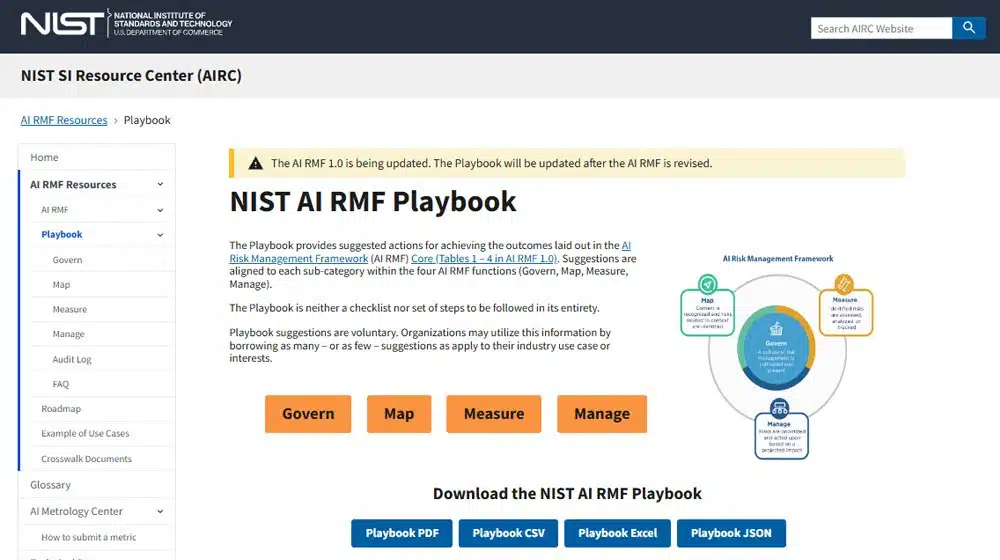
- The AI RMF Playbook, a guidebook to suggested actions and desired outcomes for governance, mapping, measuring, and managing AI risks.
- The NIST AI RMF Roadmap, a companion document that offers a likely prospective future path for the AI RMF to take in the coming years.
- AI RMF Crosswalks, a series of documents that outline cross-over mapping between NIST's AI RMF and external AI risk frameworks or laws. Examples include ISO 23984 (AI Guidance on Risk Management) and country-specific documents like Japan's AI Guidelines for Business.
- NIST AI RMF Perspectives, a series of statements offering perspectives from particular industry entities like the head of Amazon Web Services or the National Science Foundation.
Additionally, NIST has put together the AI (SI) Resource Center, AIRC, as a centralized page that accumulates the various documents, resources, guides, and more.
A more recent publication, NIST-AI-600-1, is the Artificial Intelligence Risk Management Framework: Generative Artificial Intelligence Profile. This is an additional risk management guidebook, focusing on unique risks posed by generative AI in terms of things like AI hallucinations, dangerous or hateful content, environmental impacts, data and IP privacy, and more.
Most recently, NIST also published a concept note for an AI RMF Profile on Trustworthy AI in Critical Infrastructure. This is the first step towards creating the teams that develop something like the AI RMF itself, except focused specifically on critical infrastructure. This is still fully in process, so there's no published RMF for critical infrastructure yet.
Note: The AI RMF is undergoing revision. The White House AI Action Plan has stipulated a revision of AI policies, and this AI RMF is part of what is being examined and revised according to new guidance.
That's all quite a lot of information! The question is, how do you use it?
Key Facts About the NIST AI RMF
From a tangible, company-centric point of view, what is the point of the AI RMF?
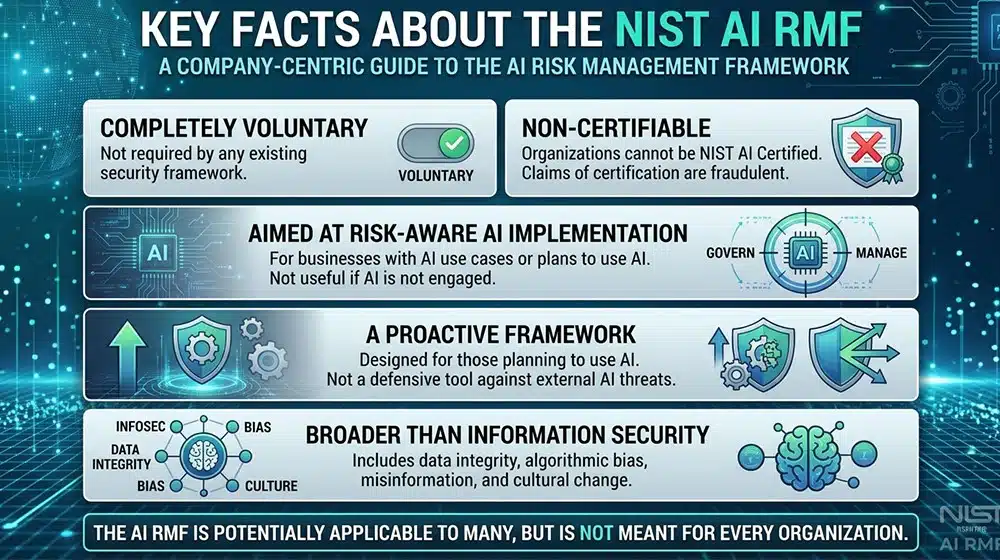
Here's what you should know:
- It is completely voluntary. No security framework requires it as of yet.
- It is non-certifiable. You can't be NIST AI Certified (and any security firm claiming otherwise is a fraud.)
- It's aimed at risk-aware implementation of AI tools. If your business has no desire to use AI, has no AI use case, or otherwise does not engage with AI, it's not a useful framework.
- It's a proactive framework meant for those who want to use AI. It's not a defensive framework to protect yourself against external AI threats.
- It's not solely focused on information security. It also includes elements of data integrity, algorithmic bias, misinformation, cultural change, and more.
As such, the AI RMF is not meant for everyone, but it is potentially applicable to a lot of organizations.
Who Can Benefit from Using the AI RMF?
Step one is to determine if using the AI RMF is even useful to your organization.
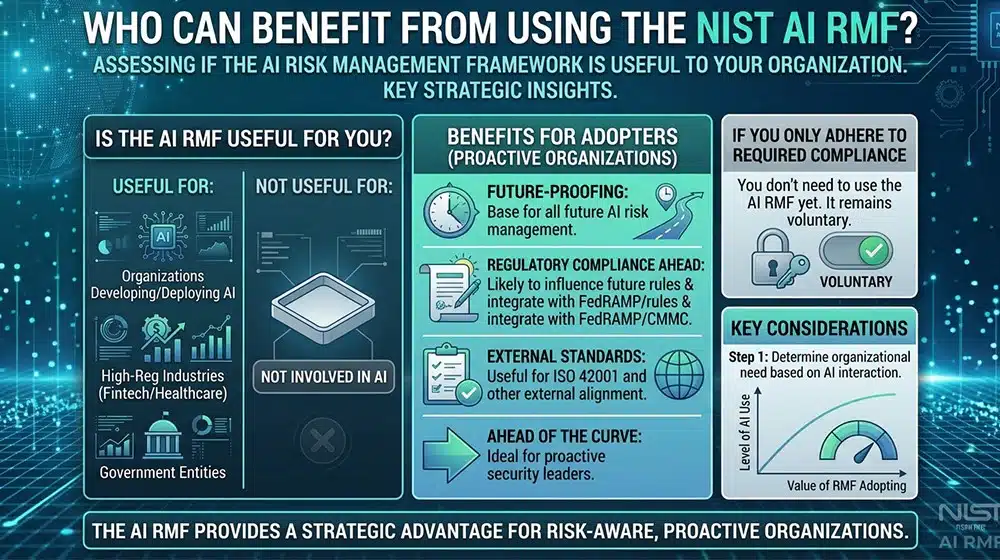
If you're an organization that uses AI tools, deploys AI systems, participates in the AI lifecycle in some way, or if you're in a highly regulated industry like fintech or healthcare, or if you're a government organization, the AI RMF can be very useful.
On the other hand, if you're not involved in AI and are not deploying AI tools for use within your organization, the AI RMF is likely not going to be useful for you.
The AI RMF is also meant to be a basis on which to stand for future-proofing AI risk management. It's likely going to be a central resource from which future AI regulations are drawn, so obtaining and using it now will put you in a good position for when those future regulations are created and/or integrated into existing risk frameworks like FedRAMP and CMMC. Likewise, if you're trying to comply with external standards like ISO 42001, it can be helpful.
If your organization likes to be proactive and ahead of the curve on security, the NIST AI RMF is a good place to start. If you only adhere to what you need to for certifications and compliance, you don't need to use the AI RMF yet.
Understanding the Components of the NIST AI RMF
The AI RMF is focused on four key functions surrounding AI adoption and use, all centered around one overall concept. That overall concept is the seven-factor concept of trustworthiness, and the four functions are governance, mapping, measuring, and management.
NIST AI RMF 7 Principles
The seven principles for the AI RMF form the conceptual foundation that drives the overall risk management framework.
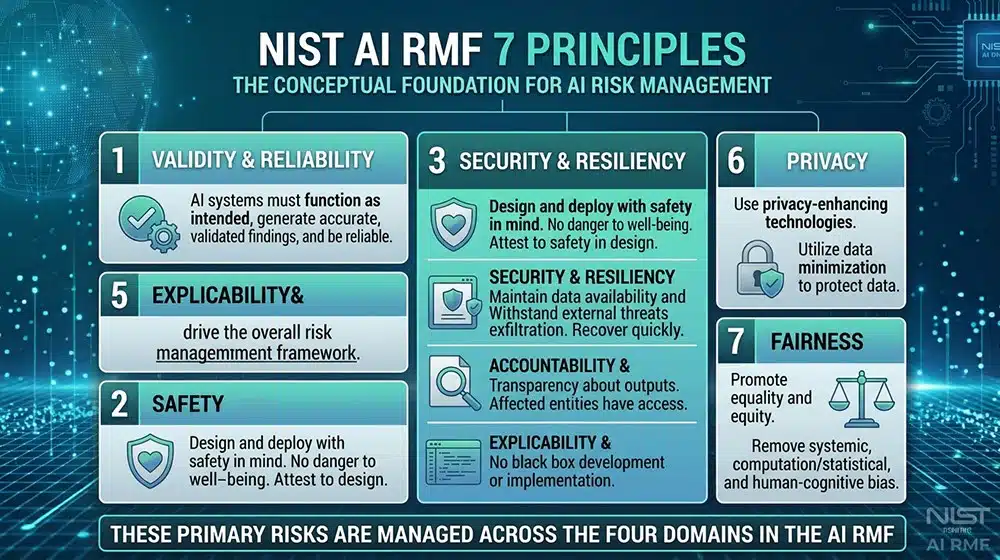
They include:
- Validity and Reliability. AI systems must function as intended without failure or reliability issues, and must generate accurate and validated findings.
- Safety. AI systems must not endanger the well-being of any involved actors, and must be designed and deployed with safety in mind. They must also have documentation attesting to safety in design.
- Security and Resiliency. AI systems must make data available and maintain data integrity, with the capacity to withstand external threats like exfiltration. They must also recover quickly and maintain operations during and after disruptions or incidents.
- Accountability and Transparency. AI systems must be transparent about their output, affected entities must have access to that information, and AI systems must be held accountable at a high level.
- Explicability and Interpretability. AI systems must be explainable and interpretable to anyone involved; no "black box" development or implementation is acceptable.
- Privacy. AI systems must use privacy-enhancing technologies and use data minimization to protect data.
- Fairness. AI systems must promote equality and equity, and must remove harmful discrimination and bias. Specifically, NIST calls out systemic, computational and statistical, and human-cognitive biases as categories that must be removed.
These are the primary categories of risk that are managed across the four domains in the AI RMF.
NIST AI RMF Governance
Of the four domains, the Govern domain is designed to cut across the other three, as an overarching combination of goal and design information. You can think of it as the top-level aspect of the RMF that the other three domains center around.
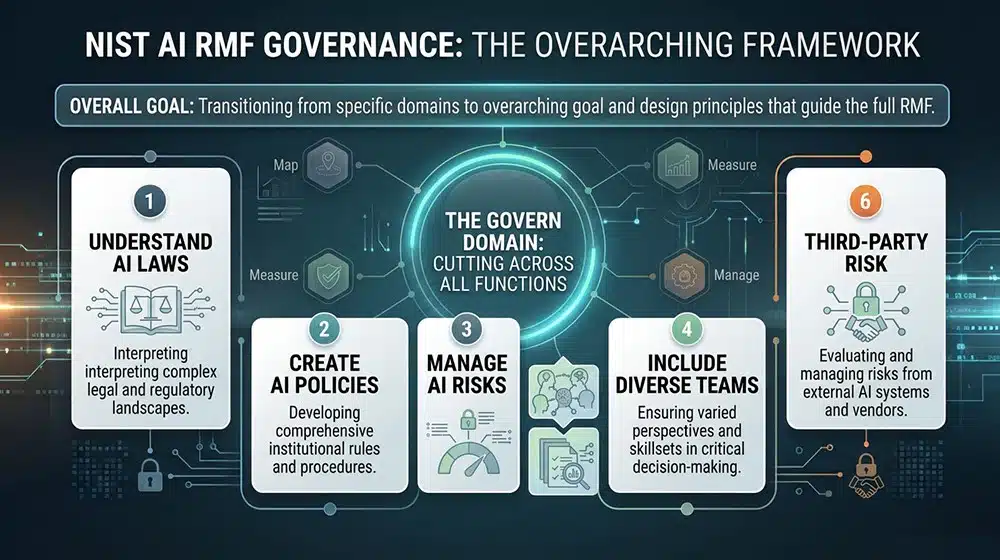
Govern has six categories, each with several subcategories. They include things like understanding, managing, and documenting AI Regulations and laws, including a diverse team in decision-making surrounding AI, and creating policies and procedures to manage AI Risks from third parties.
NIST AI RMF Mapping
Mapping is the tangible process of figuring out what risks come from what elements of AI use, and in what ways.
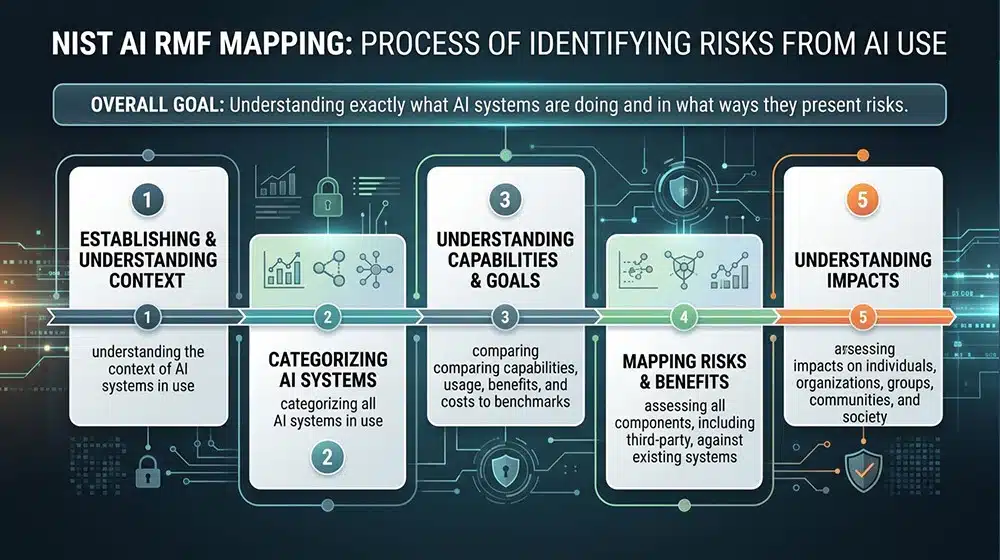
It contains five main categories:
- Establishing and understanding the context of AI systems in use.
- Categorizing all AI systems in use.
- Understanding the capabilities, goals, usage, benefits, and costs of AI systems, and comparing them to benchmarks.
- Mapping the risks and benefits for all components, including third-party components, against existing systems.
- Understanding the impacts of the AI systems on individuals, organizations, groups, communities, and even society.
Overall, this is the segment focused on figuring out exactly what the AI systems are doing, and in what ways it presents risks.
NIST AI RMF Measurement
The third domain is measurement, which is the data gathering portion of the RMF. Much of what has been established so far is conceptual; this portion is aimed at pinning down the specifics. What, actually, is the AI enabling, what benefits is it actually giving, and what drawbacks are present?
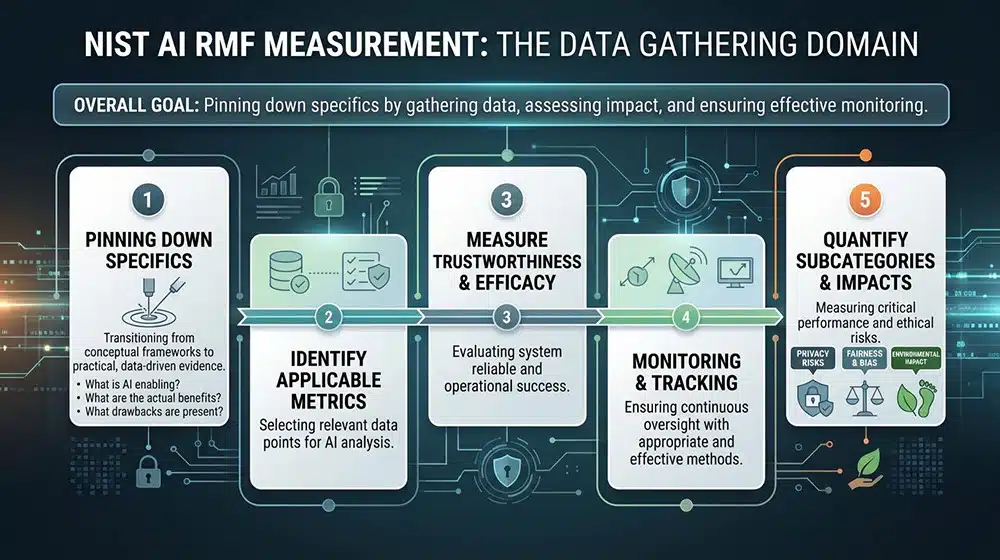
Within this domain, organizations are meant to identify applicable metrics and methods of measuring AI's impact, trustworthiness, and efficacy. This is also where you make sure you have appropriate and effective monitoring and tracking.
Subcategories include things like privacy risks, fairness and bias measurements, and environmental impact measurements.
NIST AI RMF Management
The fourth and final domain is management, and it's how all of the rest of the RMF is put into context. This is where you determine what risks to prioritize, what areas need development and monitoring and what need improvement, and how to enhance ongoing AI risk management capacity.
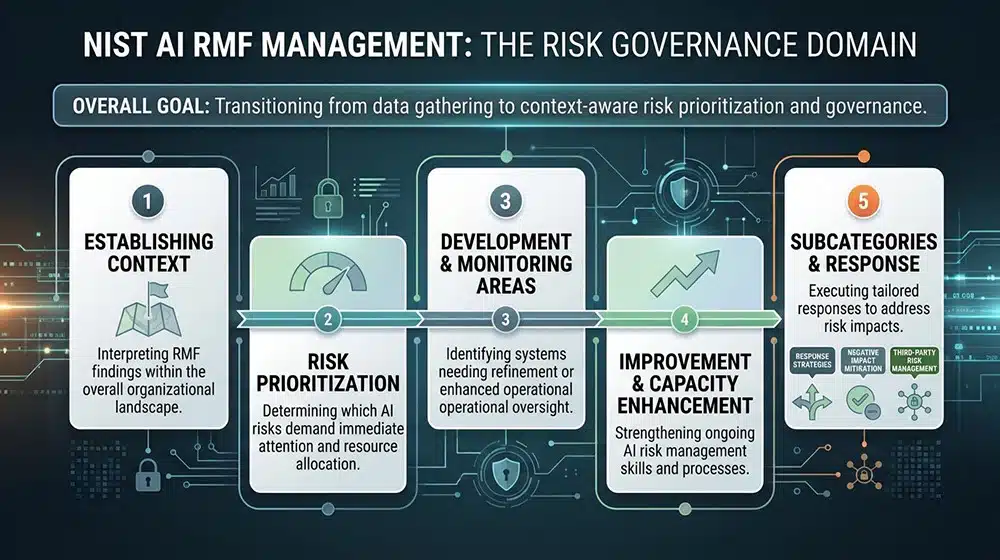
This domain also has subcategories, which include things like how to respond to risks from the other domains, how to minimize negative impacts while maximizing benefits, and how to manage risks from third parties.
Doing the Work: How to Implement NIST's AI RMF
Concept is all good, but how do you actually put any of this together?
Unfortunately, this isn't something we can pin down in a blog post. There are thousands of AI systems you might be using for a huge array of different tasks, and they're all vastly different from one another. There's no checklist or step-by-step guide to implementing any of this.
The key, generally, is to treat it just like you would any other security framework. Comb through the relevant documents, compile a team of stakeholders, and conduct deep risk assessments and risk-benefit analyses. Establish policies and procedures. Determine metrics and measurements, and benchmark them. Document everything.

Every company and organization implementing the NIST AI RMF is going to have its own way of doing it. It's all very free-form and designed more to outline how to think about the risks that come from AI than to provide a list of security controls to use with AI.
As things stand right now, managing the risks and benefits of AI is a very, very complex task. There's a lot of misinformation, inflated claims, and hidden truth involved in the AI industry, with many bad actors involved as well. Using the NIST AI RMF can be a good way to pin down what these AI systems can actually do, what risks they actually pose, and how to navigate a turbulent and rapidly evolving technological paradigm.
Even if you don't get deep into the weeds with implementation, reading and thinking about the things involved in the AI RMF can be a good way to consider the details of AI tools and systems, as well as future-proof for when AI regulations become more commonplace.

Dan Page is a seasoned Cybersecurity and Risk Management Executive known for advancing security programs aligned with complex regulatory frameworks and critical business objectives. With over 12 years in information security, his expertise began in the U.S. Army Signal Corps, where he led global communications and secured classified networks supporting Special Operations missions. Post-military, he specializes in security architecture for CUI, ITAR data, and federal cloud workloads. Currently, as Senior Cybersecurity Manager at Ignyte Assurance Platform, Dan guides organizations through compliance with CMMC, FedRAMP, ISO 27001, PCI, and NIST standards. A CISSP, CRISC, CISM, PMP, and ITIL-certified professional, he is also a cybersecurity lecturer and community volunteer advocating workforce development.