

FedRAMP has long been one of the more complex certifications you can achieve, but the rewards are well worth the effort. Validating your company's information security is a huge benefit, and on top of that, working with the government on sensitive contracts is a lucrative business venture.
We do our best to explain various aspects of FedRAMP in plain English, to make it easier to figure out what your goals should be and where you should place your efforts. Tempering expectations and keeping a realistic viewpoint is important.
One point of confusion we've encountered a lot is about the "FedRAMP Ready" status. Developing an RAR and becoming FedRAMP Ready was a common place to start, but how does it work and is it worth doing, or is it just an intermediary set of busywork that chews up time and leaves you in an awkward spot?
There's a lot to talk about here, so let's dig right in.
Warning: A good portion of what we're discussing here today is now designated Legacy information. It's valid for certain organizations, but with the changes to the FedRAMP program and the shift to FedRAMP 20x, a lot has changed. If you're new to FedRAMP and you aren't sure where to start, skip to the FedRAMP 20x section below.
 BLUF - Bottom Line Up Front
FedRAMP proves a company has strong security and opens access to government contracts. The old Readiness Assessment Report and FedRAMP Ready label now act as legacy. FedRAMP 20x replaces that model with live validation and Class A as the new entry route. If already far in the old path, finish it; if not, move to 20x. High baseline remains a special case with separate deadlines and rules.
What is the FedRAMP RAR?
First of all, what is the FedRAMP RAR in the first place?
The RAR is the Readiness Assessment Report. It's a lot like an audit report, but with lower standards and a less comprehensive outlook.
To understand why it exists, it's worth looking at the reason it was created in the first place.
In the early days of FedRAMP, you had the government agencies looking for CSPs, you had CSPs looking to work with the government, and you had 3PAOs serving as validation that CSPs did the work and were safe for the government to use.
But, since the program was relatively new, very complex, and difficult to pin down, many CSPs did a lot of work but still fell short of the mark. They would apply for a 3PAO audit, get their Security Assessment Report, and have it submitted to the FedRAMP office. Since the SAR was full of gaps and holes, the FedRAMP office could not recommend using the CSP, so they ended up denied.

Punishing CSPs with denials when they're trying to do the work but just didn't quite get there was pretty harsh, so an intermediary step was created. This intermediary is the RAR; a report that serves as a sort of status update and indication of good faith progress.
CSPs could undergo a 3PAO assessment, with a lower bar and no pass/fail attached to it. The outcome was the RAR, which could be given to both FedRAMP and to agency sponsors. The government entities can then evaluate the report and determine if the CSP is making good progress, or if it seems like they're just flailing and don't really know what to do.
CSPs that get an RAR and have a passing grade could be deemed FedRAMP Ready.
What does being FedRAMP Ready mean?
Basically, it means that the CSP is most of the way to authorization, but isn't quite there yet. They have the biggest, most important security controls implemented, but some of the details aren't all pinned down. All they need to do is finish the work (generally the least important 20% or less of the security controls list) and undergo the official 3PAO assessment for full authorization.
Critically, being FedRAMP Ready meant that t he CSP could be listed on the FedRAMP marketplace. Arguably the hardest part of FedRAMP for a CSP is finding agency customers, so this marketplace listing was both a form of public advertisement and a way for the government to find the CSP.
Is Becoming FedRAMP Ready a Good Idea Today?
You might notice a lot of use of the past tense in the above section.
That's because FedRAMP Ready status and the FedRAMP RAR are phasing out.
If your CSP is in the middle of the FedRAMP authorization path, you've already submitted your applications to the FedRAMP PMO, and you're undergoing the assessment to receive an RAR, then it's fine to continue.
If you're starting from scratch and you're seeing a lot of mentions of FedRAMP Ready, RARs, and other goals to meet, you're operating on outdated information.
Note: One exception to this is if your CSP is in a position to seek FedRAMP High (now Class D) authorization. FedRAMP 20x does not yet apply to FedRAMP High baseline; the pilot program is scheduled to begin later this year and continue through mid-2027.
Fortunately, that's why we're here to help. Read on, or feel free to reach out and contact us for more information. We help many CSPs with the FedRAMP authorization process, both with our platform and consulting services. We'd love to help you too.
FedRAMP 20x Changing the Readiness Model
With the rollout of the 2026 Consolidated Rules, FedRAMP 20x is the law of the land for the vast majority of CSPs. A lot has changed, which we've covered elsewhere on our blog, but as far as the RAR and FedRAMP Ready designation is concerned, here's what you need to know.
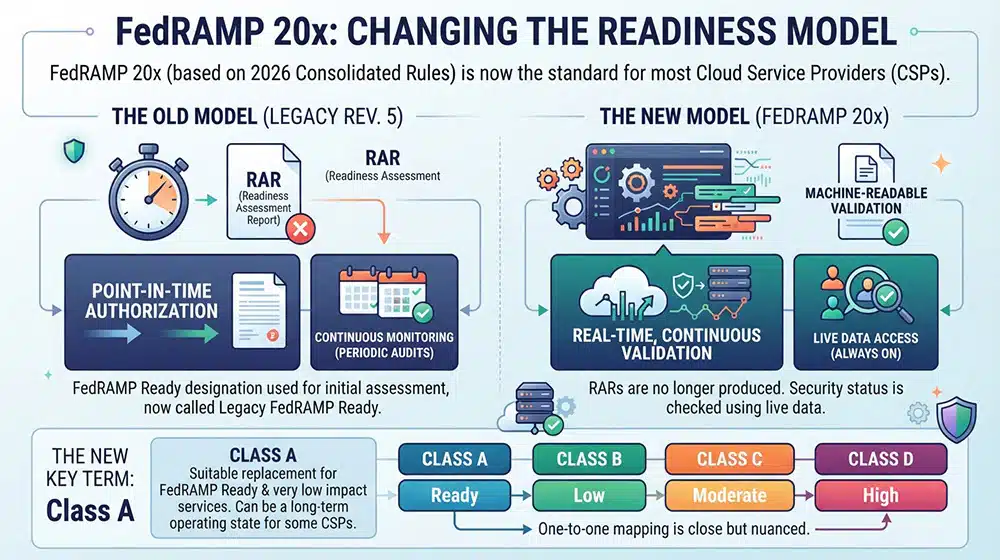
FedRAMP Ready is phased out. As of the end of July, FedRAMP Ready has been converted into Legacy FedRAMP Ready on the FedRAMP marketplace. No new applications for FedRAMP Ready are being considered for any level other than FedRAMP High (Class D), because Class D has not opened for 20x operation yet.
Any CSP currently designated FedRAMP Ready will have their designation changed to Legacy FedRAMP Ready. Other than the name change, the functionality is no different, nor is the path forward, for now. However, while you have some leeway, it's generally a good idea to convert to the FedRAMP 20x authorization path if you can make the jump easily. The legacy Rev. 5 path is not going to be around forever.
RARs are no longer produced. Again, other than the occasional report for High baseline CSPs, the Readiness Assessment Report is no longer available.
This is a significant change, and it's driven by the change in how FedRAMP functions at its core. In the past, FedRAMP has been a point-in-time authorization model with continuous monitoring meant to keep security going until the next audit.
With FedRAMP 20x, there's a huge new emphasis on machine-readable validation through documentation that updates in real time. You don't need a Readiness Assessment Report, because anyone with both the interest and the access can simply check your validation status using live data.
The new key term to research is Class A. The new structure for FedRAMP is divided among four classes, labeled A through D. While many resources, including our posts in the past, refer to these as new names for the old impact levels (mapping A to Ready, B to Low, C to Moderate, and D to High), this isn't strictly true.
While the one-to-one mapping is close, there is some nuance that is going to take getting used to as the program matures.
In particular, Class A is suitable as a replacement for the in-process FedRAMP Ready, as well as for very low-impact services. It's not strictly a temporary, transitional designation, but rather one that some CSPs will be comfortable operating in for the long term.
Seeking FedRAMP 20x Class A Status
So, since FedRAMP Class A has replaced FedRAMP Ready, should you seek it?
Probably, unless you're already in process for achieving a Class B or C designation instead.
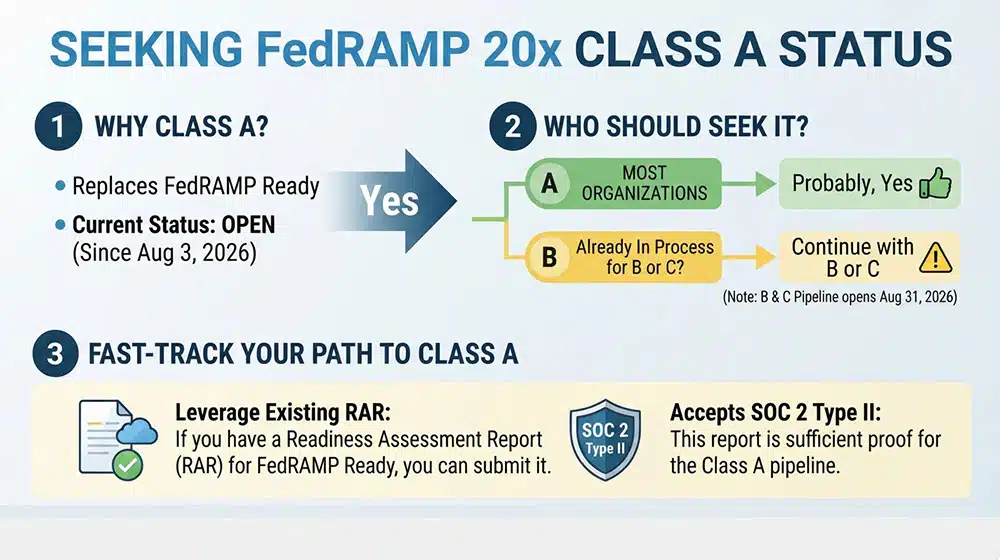
Right now, as we write this post, the pipeline for Class A is open (as of August 3, 2026) while the pipeline for Classes B and C is not yet open. That pipeline opens August 31, though, so by the time you read this, it should be open.
One benefit to the Class A designation is that you might already be most of the way there. If you've been working towards a FedRAMP Ready designation and you already have a Readiness Assessment Report, you can submit that RAR to the Class A pipeline.
Additionally, FedRAMP will be accepting a SOC 2 Type II report as sufficient proof for the Class A pipeline.
Is It Worth Seeking a FedRAMP RAR and Becoming FedRAMP Ready Today?
As you can probably guess, the answer is likely a no. There are, however, a couple of exceptions.
First: if you're already most of the way through the FedRAMP Authorization process and you're about to pull the trigger on the assessment to generate an RAR, then you can likely continue to do so. While the FedRAMP 20x path is now open to all but the highest baseline CSPs, it's not mandatory yet.
Specifically, you have until January 1, 2027, to make sure you adhere to the CR 2026 rules, and you have until June 11, 2027, to process a FedRAMP Rev. 5 certification application. After those dates, if you aren't already knee-deep in the process, you'll need to shift to the 20x authorization path in its entirety.
Next: A limited pipeline exists to transition from FedRAMP Ready to a full Class B or Class C certification. This is more or less the equivalent of going from FedRAMP Ready to FedRAMP Low or FedRAMP Moderate under Rev. 5, but since Rev. 5 is changing, so is the process.
This process can be handled through the FedRAMP CSP Ready Conversion Form. To apply for this conversion, you will need a new completed assessment, and you will need to agree to adhere to CR 2026 rules for Rev. 5 by February 19, 2027. This is the date the grace period for CR 2026 ends.
Finally, if you're a CSP aiming for a High baseline, now a Class D baseline, you only have the one option. Becoming FedRAMP Ready as a transitional step to full authorization is still available to you until the 20x pilot for Class D ends and the new Class D authorization path is fully rolled out.
We understand that all of this is very complicated. The government is usually very slow about rolling out significant changes to programs specifically because this complexity can cause all manner of problems. However, the cybersecurity environment and the rapidly escalating sophistication of information threats have necessitated a much more rapid shift in the program.
So, for a while, we have two overlapping, often contradictory paths to authorization.
The short version, really, is that if you can convert to the new path, do so. The sooner you can do it, the better.
If you're already too deep in the old Rev. 5 path to change now, then see it through to the end, and then start work on the transition. You'll be right there beside all of the other currently-authorized and pending CSPs that need to make that transition with you.
And, in a couple of years, we'll put the Rev. 5 path behind us and fully transition to FedRAMP 20x, with robust machine-readable proof, rapid authorization, and a much lower-friction program. It will be worth it when it's done, but for now, we just have to muddle through.
How Ignyte Can Help
So, where do we come in?
Well, for one thing, you've read this informational article that should have clarified the situation for a lot of you. Our blog is full of these kinds of explainers, and we're always open to suggestions of other topics to cover. If you don't see one, just ask.
We're deep in the FedRAMP program, so we also offer our expertise. You can reach out to us for a consultation and expert advice, though if you're interested in using our services as a 3PAO (or, under 20x, Independent Assessment Service), we'll need to be limited in our guidance.

Our flagship product is the Ignyte Assurance Platform. We created the platform from the ground up to be a tool meant for streamlining FedRAMP authorizations. The platform tracks your security controls and implementation tasks, and helps you go through the authorization process as quickly as possible.
Yes, FedRAMP 20x has done a lot to make the process faster and more automated. But you still need to do the work, which means you still need to track and have awareness of what work needs to be done. That's where the platform comes in. To see how it can work for you, book a free demo today.

Max Aulakh is a distinguished Data Security and Compliance leader, recognized for implementing DoD-tested security strategies and compliance measures that protect mission-critical IT operations. His expertise was shaped in the United States Air Force, where he was responsible for the InfoSec and ComSec of network hardware, software, and IT infrastructure across global classified and unclassified networks. He also developed strategic relationships with military units in Turkey, Afghanistan, and Iraq. After his tenure with the USAF, Max played a pivotal role in driving Information Assurance (IA) programs for the U.S. Department of Defense (DoD). As a Senior Consultant for a leading defense contracting firm, he led a team that ensured data centers met Air Force Level Security audits for regulatory requirements like HIPAA, SOX, and FISMA. Currently, as the CEO of Ignyte Assurance Platform, he is at the forefront of cyber assurance and regulatory compliance innovation, catering to defense, healthcare, and manufacturing sectors. Max is also an esteemed speaker, having presented at several conferences on topics including cybersecurity GRC, medical device security, and cybersecurity perspectives in vendor management. You can follow him in LinkedIn here.