

One of the biggest changes to the FedRAMP program in the history of the program itself is in progress, and it's going to change a lot of things for a lot of people. When the dust settles, it should be a net benefit across the board, but in the meantime, it's going to cause a lot of confusion.
Here at Ignyte, we've been doing a lot to get ready, both as a service provider and as a 3PAO. We've been keeping tabs on what you need to know, and we'll do our best to help you navigate the changes as they occur.
Let's start at the beginning with what FedRAMP 20x is, and run down everything you need to know as a CSP.
 BLUF - Bottom Line Up Front
FedRAMP 20x is a major FedRAMP update that will speed authorization, replace narrative plans with machine-readable Key Security Indicators, and cut paperwork. Pilots for Low and Moderate are complete; submissions open July 2026 for Class A–C, Class D pilot in FY27 Q1, and Rev5 will retire end 2027. CSPs must pick a path: plan, finish on Rev5, shift to 20x, or convert existing certification, and integrate machine data as Key Security Indicators.
What is FedRAMP 20x?
Near the start of 2025, FedRAMP started the pilot program for FedRAMP 20x. We've talked about this before, but it's worth going over again.
FedRAMP 20x is a modernization effort for the stagnant FedRAMP authorization process. It streamlines the requirements for authorization, including implementation of many security controls, so there's less question and less room for variability in implementation. In some ways, it's almost the opposite of ISO 27001's descriptivist approach to an ISMS; it lays out more specifics on what you need to do to achieve authorization.
The main goal for this is not to tighten the reins of security. Instead, it's to streamline and speed up the evaluation process.
The changes made to the program allow a lot of your security to be validated automatically, using machine processes and machine-readable reporting. There are far fewer pieces of paperwork and individual artifacts, and more spreadsheets that can be reviewed by a program instead of a person.
To put this into perspective, the normal FedRAMP authorization process could take 18 months or even longer in some cases. Under FedRAMP 20x, full authorization was achieved in under three months.

You've likely heard a lot about FedRAMP 20x as something looming on the horizon. The nature of the pilot meant that it was limited in enrollment and started with Low baseline CSPs, so the audience was very limited.
A second pilot, focusing on Moderate baseline CSPs, recently completed. Now we're poised for Phase 3 of FedRAMP 20x implementation: Wide-scale Adoption of FedRAMP 20x.
Note on the matter of Class: Part of 20x is a change in terminology to reduce confusion with the levels used by CMMC and other certifications. Moving forward, Li-SaaS and Low will be Class B, Moderate will be Class C, and High will be Class D. Class A is a pilot class, which is the equivalent of FedRAMP Ready. We'll likely use both moving forward, for a while, until the new terminology is cemented in everyone's minds.
The phase one and two pilots identified minor issues, but no major roadblocks, so now FedRAMP 20x is poised to roll out beginning in just a matter of weeks as of this writing.
That means you need to be ready to adapt, according to your business needs.
What is the FedRAMP 20x Timeline?
With the pilots over, we're ready for the first major roll-out of FedRAMP 20x. Add it to the pile along with all of the other big changes coming in 2026.
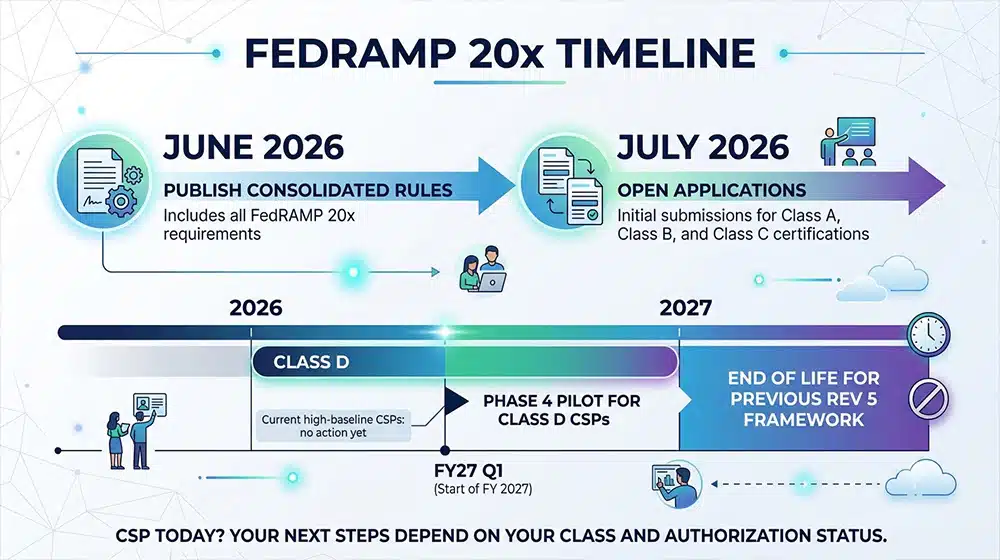
By the end of June 2026, the FedRAMP program management office will publish the FedRAMP consolidated rules for 2026, which will include all of the requirements for FedRAMP 20x.
FedRAMP 20x application submissions will open shortly after, beginning in July 2026. These initial applications will be available only to Class A, Class B, and Class C certifications.
If you're a CSP operating at the current FedRAMP High baseline (the new Class D), you currently do not need to do anything. Changes will be coming for you eventually, but not yet. Since Class D has the strictest requirements and the steepest penalties, while being one of the smallest groups of CSPs in the FedRAMP program, it's getting special treatment.
That special treatment begins with FedRAMP 20x Phase 4, which starts at the beginning of FY27 Q1, with a pilot for Class D CSPs. Assuming that goes smoothly, and there are no major interruptions to the FedRAMP 20x program, it's expected that the previous FedRAMP Rev 5 framework will be End of Life by the end of 2027.
So, what do you need to do as a CSP today? It depends on what Class your CSP occupies and where you are in the authorization process.
Determine Your FedRAMP Class
As mentioned above, part of the FedRAMP 20x transition is a change in terminology. It's important to understand what your CSP's class is.

If you are currently, or are planning to become, authorized at a High (Class D) baseline, you have time and don't need to make any major changes right now. Stay tuned and pay attention to the coming pilot and its outcomes, and be prepared for changes that will come in 2027 and beyond.
If you are currently, or are planning to become, authorized at a Class A/B/C (Ready, Li-SaaS, Low, or Moderate) baseline, move on to the next section.
Broadly, we can consider that there are 4 possible states your CSP can be in with regard to authorization. Or, rather, certification; another terminology change with FedRAMP 20x is finally calling it a certification.
The next steps you should take depend on where you are in this process.
Possibility 1: Planning to Seek Certification
The first possibility is that you're planning to seek certification, but you haven't done much to get there just yet. Maybe you're investigating the list of security controls and starting to develop implementation plans. Maybe you're calling around to various vendors and service providers that can help you out. Maybe you're in discussions with a FedRAMP advisor or consultant to make the process smoother.
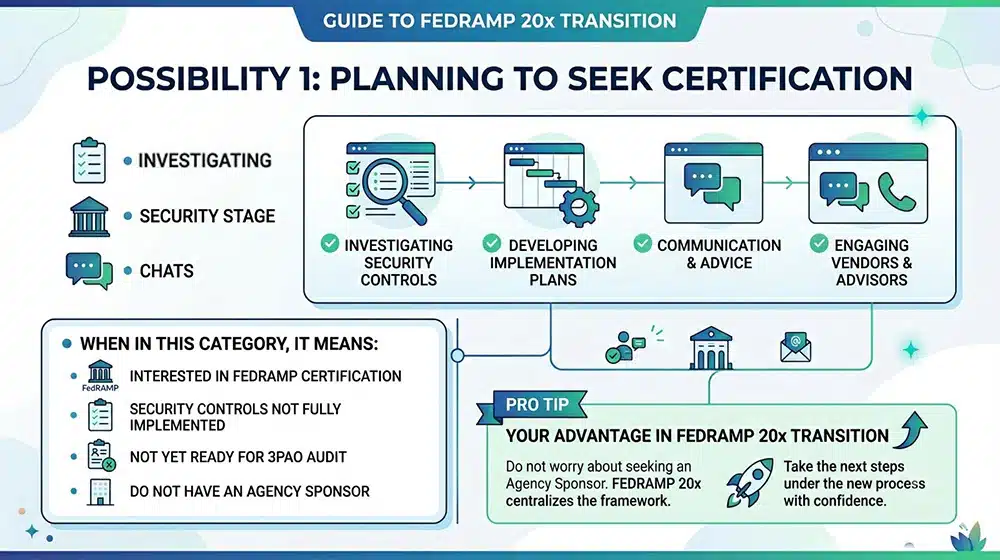
Whatever the case, when you're in this category, it means:
- You're interested in becoming FedRAMP certified.
- You have not yet implemented all of the security controls.
- You are not yet ready for a 3PAO audit.
- You do not have an agency sponsor.
In some ways, you are in the best position for the FedRAMP 20x transition. You have done relatively little work so far under the Rev5 paradigm, and you can take the next steps under the new process with confidence.
First up, you do not need to worry about seeking an agency sponsor before you can get your certification. FedRAMP 20x does away with the need for agency sponsorship, centralizing and defragmenting the framework and making CSPs more broadly available to government departments that want to use them.
Refer to the Major Changes section below for a more thorough rundown of what you'll need to keep in mind.
Possibility 2: Actively Seeking Readiness
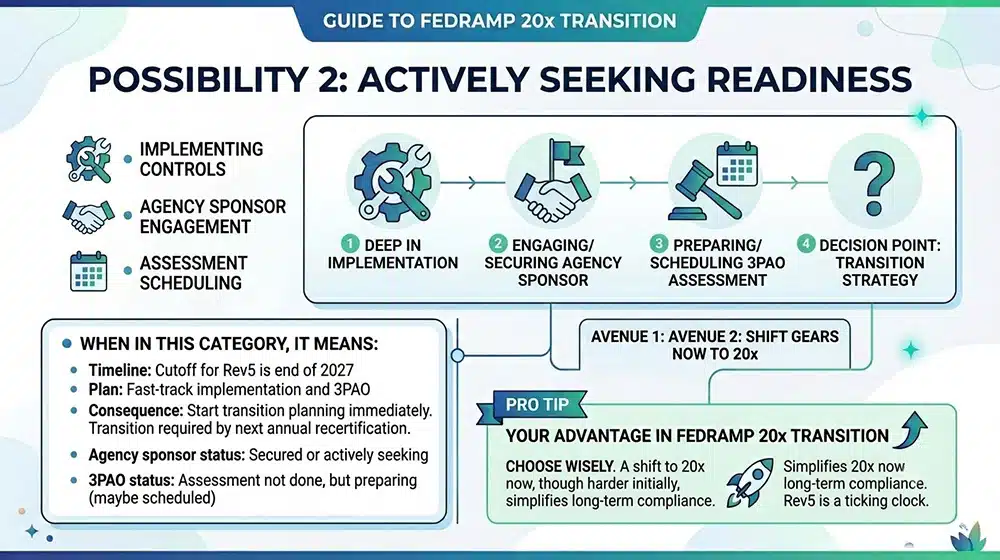
If you're actively seeking readiness, it means you're neck-deep in implementation. You likely have an agency sponsor, or are at least actively seeking one. You have not yet undergone a 3PAO assessment, but you're preparing for one, and may even have one scheduled.
At this point, you have two options.
The first is to go full steam ahead, pushing the timeline as much as you can to get certified as soon as possible. FedRAMP does not plan to cut off the Rev5 authorization path until the end of 2027, so you have until then to finish with the process.
If this is the avenue you choose, you will likely want to begin thoughts of transition as well. Even if you make it in under the cutoff, you will only have until your recertification before you will need to have made the transition. Since you have to undergo a 3PAO assessment every year, you should consider having your shift to 20x ready to go by your next assessment.
The other option is to shift gears now. It will likely cause some delays in your timeline, at least initially, while you change your documentation and reporting to modernized and machine-readable systems. It will also likely spike your costs. But when it's done, you'll be ready to apply using the 20x process and will be good to go thereafter. It's the higher initial effort, smoother ongoing process option.
Possibility 3: Ready and Waiting
The third status you can have as a CSP is when you're ready and waiting. Either you've fully implemented security and are waiting for a 3PAO assessment, or you've gotten your assessment and a readiness report submitted to the PMO, or some other near-complete status. Basically, you've done the work, but the final authorization hasn't been stamped yet.
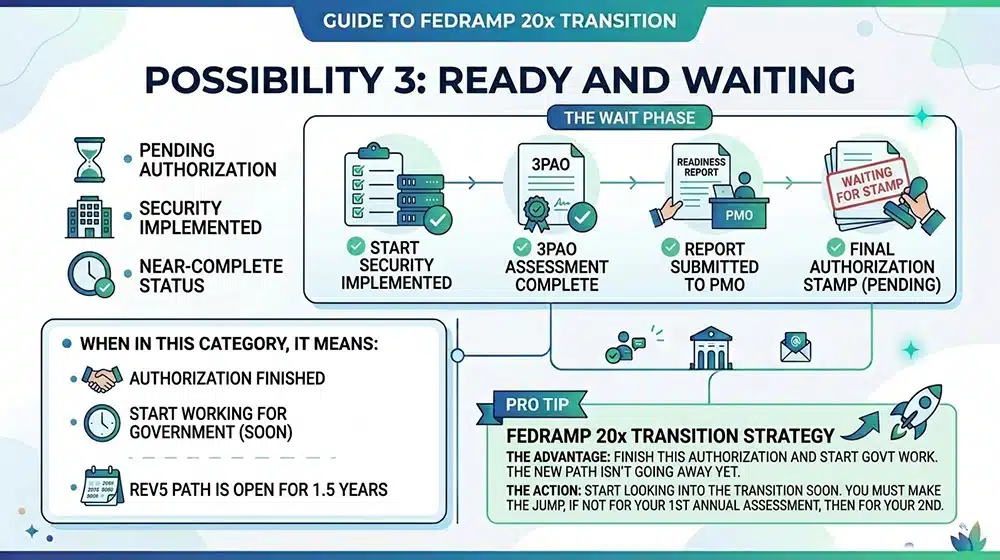
The upshot is, since the Rev5 authorization path is not going away for another year and a half, you will still be able to finish this authorization and start working for the government. The downside is, you will need to start looking into the transition to FedRAMP 20x soon, because you'll need to make that jump, if not in time for your first annual assessment, then likely for your second.
Possibility 4: Fully Certified
If you're already FedRAMP certified under Rev5, you don't need to worry about the authorization part of the process. What you do need to worry about is the significant technological shift to go from the old, narrative-style System Security Plan to the new, machine-readable Key Security Indicator method.
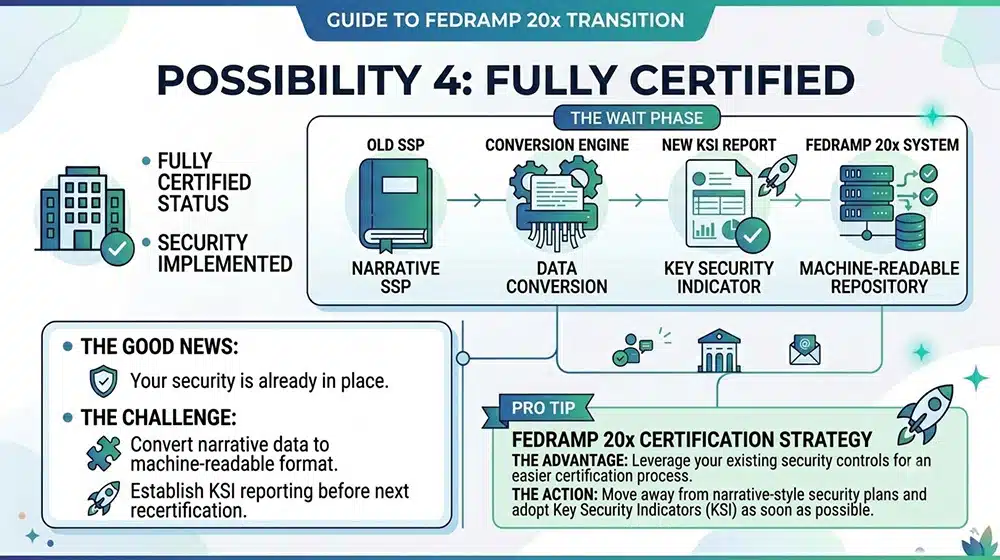
The good news is, your security is in place, so you already have what you need. The bad news is, you need to figure out how to get that information converted into KSI reporting in the proper format. That will be your burden to carry until such time as you recertify under the FedRAMP 20x framework.
Major Changes with FedRAMP 20x
Finally, we get to the actual, tangible details. What is different with FedRAMP 20x, and what do you need to focus on as a CSP?
Documentation is changing. In the past, you needed to spend a lot of time and effort compiling various forms of documentation, including evidence and artifacts that prove you're meeting every security control that applies to your business.
With FedRAMP 20x, a large amount of that documentation is now required to be integrated into your systems. Instead of pulling audit logs and generating reports for assessment, you submit the audit logs. Instead of drafting an attestation that your security is configured properly, you submit your configurations directly. All of this allows for a much faster, more automated process.
This will require a major shift in attitude and implementation for many CSPs. Fortunately, most of the largest security applications you'll be using will have functions for this built in already; you just need to identify them and how to integrate them into your reporting.
The key is Key Security Indicators. Key Security Indicators are your machine-readable output that represents the successful implementation of security. Some security controls represent multiple KSIs; some KSIs represent multiple controls. It's not a simple 1:1 checklist. It will take a lot of planning to trace and implement properly.

Sponsorship is changing. As mentioned above, FedRAMP 20x does away with the requirement to have an agency sponsor before you can seek certification. If you're in a position where you already have active contracts or sponsorships from agencies, you don't lose those. This change applies in two situations.
The first is for CSPs that are not yet certified. You don't have to find an agency sponsor to get certified; you can just do it, and then pitch yourself to agencies as contracts.
The second is for CSPs that are already certified. Instead of needing to go through a reauthorization process with new agencies for new contracts, those new agencies can just pick up your service. This opens up your horizons considerably.
The timeline is changing. One of the biggest changes in FedRAMP 20x is a much faster time to authorization. You don't need to schedule your evaluation a year or more out; the timeline is expected to shrink to just a few months when all is said and done.
Be aware, though, that there will likely be wait times anyway. The change and increasing interest in FedRAMP due to the ease of 20x will spur interest. Plus, many 3PAOs are also C3PAOs, and there's going to be a lot of demand for them soon. Open the lines of communication early, and schedule appropriately.
Make no mistake; FedRAMP 20x is going to require some serious engineering investment, and may take time to implement, regardless, but the bottleneck won't be agency sponsorship or long-wait 3PAOs now.
Throughout all of this, we're here to help. The Ignyte Assurance Platform, formerly one of your best tools for compiling evidence for your system security plan, will also be a great testbed for KSI documentation, as well as task progress tracking and collaboration as you implement FedRAMP 20x. To see how it will work for you, just reach out for a demo and discussion. We're more than happy to help you get the ball rolling in the new world of FedRAMP 20x.

Max Aulakh is a distinguished Data Security and Compliance leader, recognized for implementing DoD-tested security strategies and compliance measures that protect mission-critical IT operations. His expertise was shaped in the United States Air Force, where he was responsible for the InfoSec and ComSec of network hardware, software, and IT infrastructure across global classified and unclassified networks. He also developed strategic relationships with military units in Turkey, Afghanistan, and Iraq. After his tenure with the USAF, Max played a pivotal role in driving Information Assurance (IA) programs for the U.S. Department of Defense (DoD). As a Senior Consultant for a leading defense contracting firm, he led a team that ensured data centers met Air Force Level Security audits for regulatory requirements like HIPAA, SOX, and FISMA. Currently, as the CEO of Ignyte Assurance Platform, he is at the forefront of cyber assurance and regulatory compliance innovation, catering to defense, healthcare, and manufacturing sectors. Max is also an esteemed speaker, having presented at several conferences on topics including cybersecurity GRC, medical device security, and cybersecurity perspectives in vendor management. You can follow him in LinkedIn here.