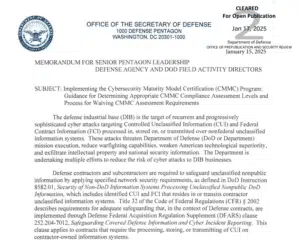

 BLUF - Bottom Line Up Front
The FedRAMP Equivalency memo allows the Department of Defense to recognize certain FedRAMP Authorized Cloud Service Providers as meeting DoD requirements, reducing duplicate audits and speeding up cloud adoption. This shows DoD trust in FedRAMP, enhancing its role as a federal standard. Cloud providers gain faster access to DoD, defense contractors see clearer compliance paths, and the federal cloud community benefits from strengthened FedRAMP credibility. Challenges include maintaining security standards for higher-sensitivity data.
Why Does This Memo Matter?
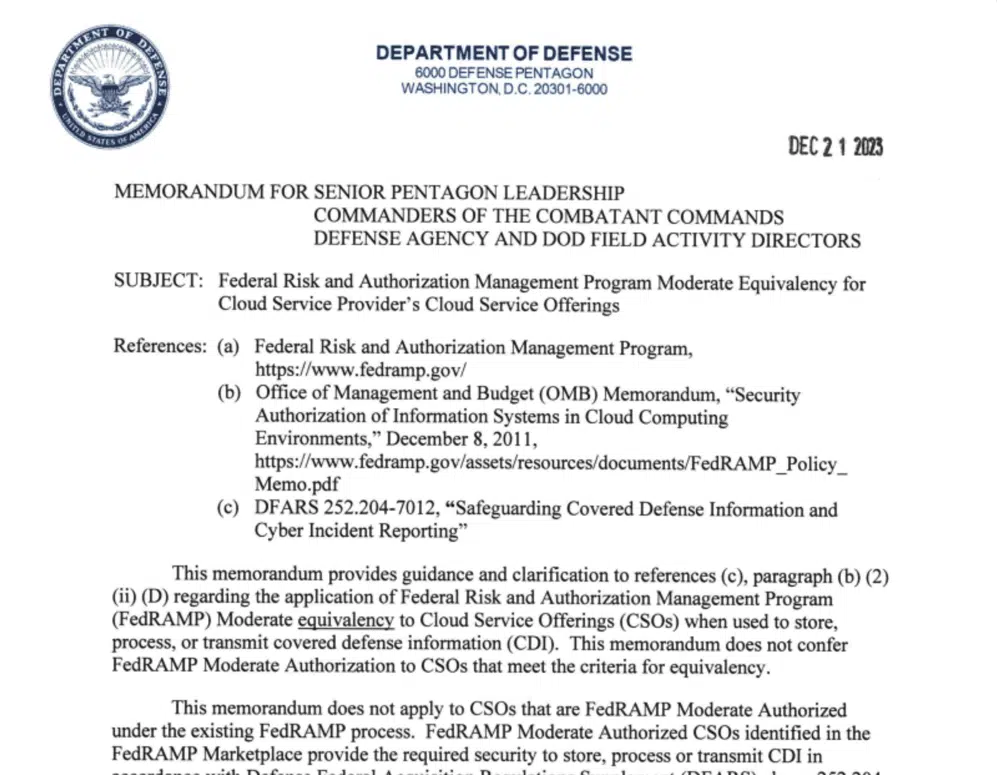
The FedRAMP Equivalency memo matters because it establishes the Department of Defense's official stance on how certain FedRAMP Authorized Cloud Service Providers (CSPs) can be treated as equivalent to DoD-specific authorization requirements. Here's why it's significant:
1. Reduces Duplication of Effort
Normally, a Cloud Service Provider has to go through two separate processes:
- FedRAMP Authorization (run by GSA for federal use).
- DoD Provisional Authorization (PA) via DISA for DoD workloads.
The memo allows some FedRAMP Authorized CSPs to be recognized as equivalent for certain use cases. This reduces the need for duplicate audits and security reviews.
2. Streamlines DoD Cloud Adoption
By acknowledging FedRAMP security baselines as "good enough" in specific scenarios, the memo accelerates cloud adoption across the DoD. Agencies can move faster to contract cloud services instead of waiting months (or years) for a separate DoD PA.
3. Signals DoD's Trust in FedRAMP
The memo is also a policy signal: DoD trusts the FedRAMP process enough to leverage it for part of its mission. That recognition strengthens FedRAMP's standing as the de facto federal cloud security standard.
👉 In short: This memo matters because it reduces redundancy, speeds adoption, clarifies boundaries, and sets a common DoD standard for using FedRAMP cloud services.
How Does This Impact Various Stakeholders?
⚡ Summary:
- CSPs → faster access to DoD.
- DoD programs → faster cloud adoption.
- Contractors → clearer compliance path.
- DoD CIO/DISA → more efficient oversight.
- Federal community → stronger FedRAMP credibility.
Cloud Service Providers (CSPs)
- Benefit: If already FedRAMP Authorized, they may not need to go through the full DoD Provisional Authorization (PA) for certain workloads (especially IL2).
- Impact: Lowers cost, reduces time to market with DoD customers, and increases competitiveness.
- Limitation: For IL4/5/6 data, they still must pursue additional DoD authorizations - so equivalency doesn't eliminate all barriers.
Defense Contractors / Integrators
- Benefit: Greater clarity when choosing cloud providers for projects - FedRAMP Authorized CSPs can often be leveraged without redundant reviews.
- Impact: Simplifies compliance strategy, lowers barriers for smaller contractors to work with DoD, and reduces audit fatigue.
- Limitation: Contractors working with Controlled Unclassified Information (CUI) or higher-sensitivity workloads may still face the full DoD authorization path.
The Broader Federal Cloud Community
- Benefit: DoD's recognition of FedRAMP strengthens trust in FedRAMP across all federal agencies.
- Impact: Encourages harmonization between civilian and defense cloud security, lowering cost of compliance nationwide.
Limitation
If equivalency is perceived as "watering down" security, it could face pushback from security-sensitive stakeholders.